
Just One More Day
Delivered by Student Rabbi Ben Russell on Erev Shabbat & Sh’mini Atzeret 5787
Once again, we find ourselves at the beginning of yet another Jewish holiday. We seem to have been doing this for a while now.
We began preparing during the month of Elul. We gathered for S’lichot. We came together for Rosh Hashanah. We listened to the shofar. We entered the Ten Days of T’shuvah. We came back for Kol Nid’re and Yom Kippur. We confessed. We fasted. We remembered. We asked ourselves difficult questions.
Then, almost immediately, Judaism sent us outside. We built a sukkah. We picked up the lulav and the et’rog. We ate. We celebrated. We were commanded to rejoice for seven days.
Seven. The number for complete. We should be finished. But the Torah says: one more day. Sh’mini Atzeret—the eighth day of Atzeret—of stopping, being held back, staying.
Stay! Don’t leave yet! Just one more day!
And our ancient rabbis tell a beautiful story to explain why this strange eighth day exists at all. They imagined a king who had gathered his children for a great celebration. They had been together for days, but eventually, as in all celebrations, it became time for everyone to go home. And the king said, “Your leaving is difficult for me. Stay with me one more day.” And so the children stayed.א
That is how our tradition imagines God on Sh’mini Atzeret: “Stay! Don’t leave yet! Just one more day!”
Throughout the year, I’m fortunate to have sessions with my mash’pi’ah—a kind of spiritual advisor. This past week, she described Sh’mini Atzeret to me as a kind of chatimah—a seal, a final closing.
We encounter a chatimah when we pray. A blessing may unfold over many words—praise, longing, gratitude, petition—but eventually it arrives at its closing words: Baruch attah Adonai… That final blessing gathers up everything that came before it and brings it to its conclusion.
There has to be a seal.
Sh’mini Atzeret, she suggested, can be understood in much the same way: as the chatimah—the sacred seal placed upon this entire season.
And perhaps that is what this day gives us. We have spent this entire season opening things. Opening the year. Opening ourselves. Opening old wounds. Opening questions. Opening the gates. But eventually everything that opens has to close. There has to be a seal.
But before we run headlong into whatever comes next, Judaism gives us this strange little space. Stay.
We have done a lot of Judaism. Together, we have blown the shofar. We have confessed. We have fasted. We beat our chests. We prayed. We built. We shook the lulav. We ate in the sukkah. We sang. All together.
Again and again, there are these moments when the noise recedes enough for encounter to happen.
And now, at the end of the season, maybe God just wants some one-on-one time with each of us.
There is something woven deeply into Jewish spiritual life that calls us away from the noise for a moment and into encounter. Abraham sits at the entrance of his tent among the terebinths of Mamre, and God appears to him there. Isaac goes out toward evening—lasuach bassadeh—to meditate in the field (Gen. 24.63).ב Moses encounters God at the burning bush after he has gone out beyond the wilderness. Elijah discovers God, not in the wind, the earthquake, or the fire, but in the kol d’mamah dakkah—the thin, quiet voice out in the wilderness.
Again and again, there are these moments when the noise recedes enough for encounter to happen.
And Judaism actually gives us language for doing this. Har’pu ud’u ki anochi Elohim. “Be still, and know that I am God” (Ps. 46.11).ג Let go. Release. Loosen your grip. Har’pu. Let go. Ud’u. And know.
There is something deeply contemplative about learning to experience life that way. Usually, we are listening while preparing our response. We are praying while thinking about what comes next. We are eating while looking at a screen. We are walking while listening to something. We are sitting still while mentally going through tomorrow’s list. We are very rarely just where we are in the moment. This is something I have been trying to learn to do better.
There is nothing magical or inherently holy about my willow tree. It’s just that I have practiced paying attention there.
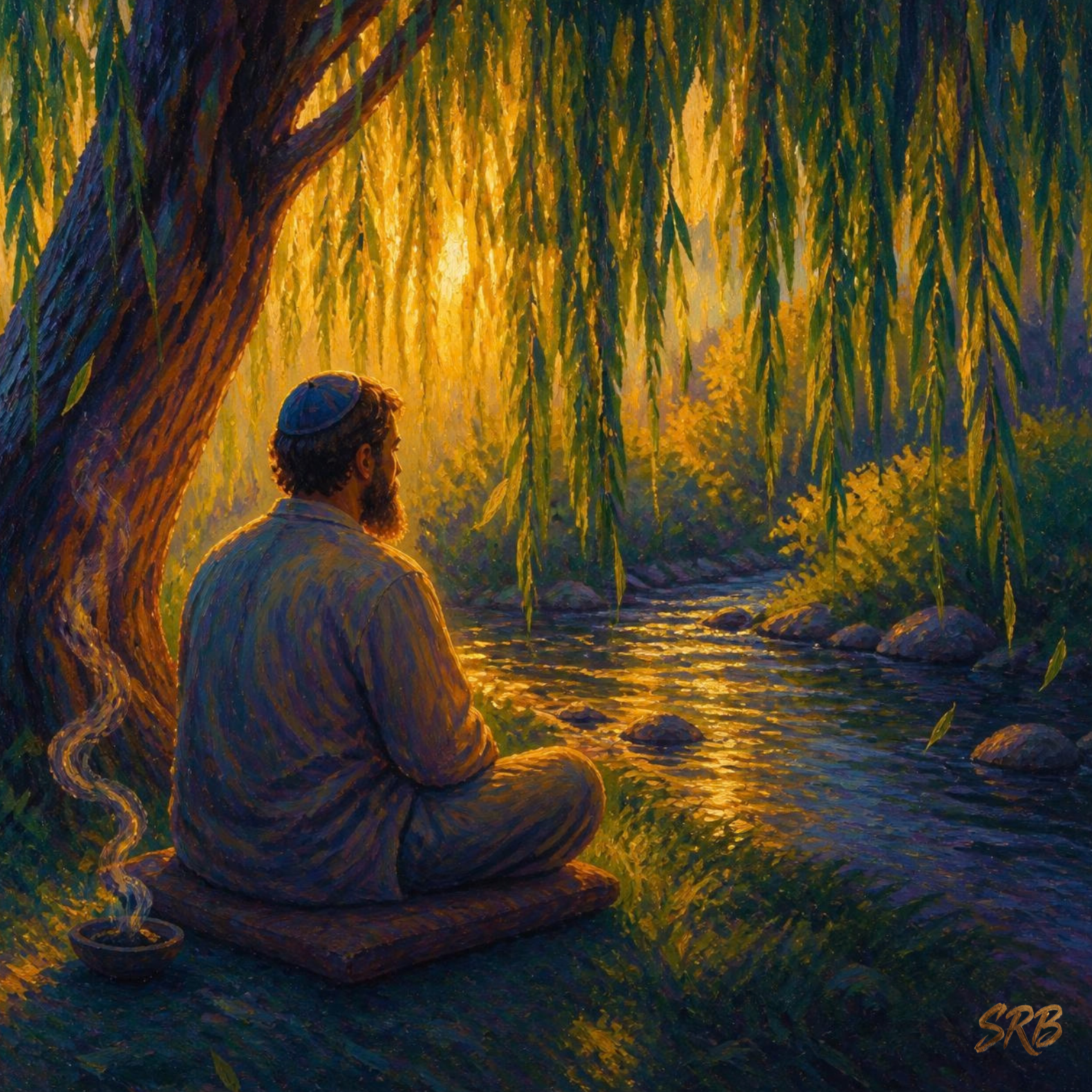
Some of you have heard me talk recently about the willow tree in my backyard. Joey certainly has. And we now have a running joke about the increasingly elaborate spiritual relationship I seem to be developing with this tree. But the truth is, it has become a sacred place for me.
I have made a place beneath it where I can sit. Sometimes I light incense. Sometimes I meditate. Sometimes I pray. Sometimes I just sit there and listen—sh’ma. To the creek. To the wind. To the leaves moving above me. To whatever is happening inside of me that I haven’t been quiet enough to notice yet.
And sometimes nothing particularly profound happens. That’s important too. The heavens do not open. The willow has not spoken Hebrew. Just sitting there is enough.
There is nothing magical or inherently holy about my willow tree. It’s just that I have practiced paying attention there. Abraham had the terebinths. Isaac had his field. Moses had the wilderness. I have my willow.
What do you have?
What do you have?
It may not be a willow, or incense, or a prayer book. But I do want to invite you to find the place or the practice where you can stop. Where is the place where you can practice har’pu? Where can you go to loosen your grip? Where is your place where you can become quiet enough to say hinneini—I am here—and actually mean it?
Because after this weekend, the Jewish calendar is going to get much quieter. For more than a month, the calendar has been doing some of our spiritual work for us.
The shofar practically screamed at us: “Wake up!” Yom Kippur took away our food and our ordinary routines and said: “Pay attention.” The sukkah has taken us out of our houses and said: “Look at the beauty and fragility of all of this!”
There will just be Monday.
The holidays create these enormous sacred containers and invite us to pay attention. And then they end. We return to ordinary time.
There will be no shofar next Monday morning demanding that you wake up. There probably won’t be a sukkah outside reminding you of life. There will just be Monday. And Tuesday. And Wednesday. And Thursday… There will be work and laundry and traffic and dishes and emails and appointments and arguments and groceries.
How will you remain awake when the holidays stop waking you up? What will sustain your spiritual life when the calendar isn’t doing it for you?
How will you remain awake when the holidays stop waking you up?
Maybe you sit quietly for five minutes in the morning. Maybe you walk. Maybe you light a candle. Maybe you take one verse of Torah and turn it over and over in your head. Maybe you sit outside. Maybe you say a new prayer every day. Maybe you find your own willow. Not because you need to accomplish something there. Not because you need to have a spiritual experience. But because relationship needs time.
And maybe the universe—maybe God—really does crave some one-on-one time with us. Maybe after all these weeks of our asking God to hear us, Sh’mini Atzeret is the moment when God says: “Now listen. Stay with Me. Don’t rush off. Just one more day.”
And maybe one day you will know.
Har’pu. Let go. Sh’ma. Listen. Stay. And maybe one day you will know.
,שבת שלום ויום טוב
Student Rabbi Ben
References
א Rashi reads atzeret as being held back or detained. He explains it with the parable of a king who asks his children to stay one more day because their leaving is hard for him (Rashi).
Rashi. “Rashi on Leviticus 23:36.” Translated by M. Rosenbaum and A. M. Silbermann, Sefaria, www.sefaria.org/Rashi_on_Leviticus.23.36.
ב The Hebrew is לָשׂוּחַ בַּשָּׂדֶה. Brown, Driver, and Briggs treat שׂוּחַ (suach) as a rare verb meaning “meditate, muse,” and note that its derivation is uncertain (Brown et al.). Jewish tradition reads Isaac’s sichah here as prayer. The Talmud uses the verse to credit Isaac with the afternoon prayer (Berakhot 26b).
Brown, Francis, et al. The Brown-Driver-Briggs Hebrew and English Lexicon. Hendrickson, 1996.
“Berakhot 26b.” The William Davidson Talmud, translated by Adin Even-Israel Steinsaltz, Sefaria, www.sefaria.org/Berakhot.26b.6.
ג The verb har’pu, from רפה, can mean letting go, relaxing, ceasing, or releasing. That gives the verse a wider range than the English “be still” alone. The translation is my own.