Judaism Misses You
Delivered by Student Rabbi Ben Russell on Yom Kippur Morning 5787
Last night, I asked us to look. To look honestly. To look gently. To let the light reach the places we might rather leave hidden. Because before we can change anything, we have to be willing to see what is actually there.
And this morning, Yom Kippur gives us words for what we find.
Ashamnu. Bagadnu. We have been guilty. We have betrayed.
Not: I have been guilty. I have betrayed. We.
That is strange when you think about it. Over the course of Yom Kippur, we will confess things some of us have never done. We will confess things we cannot imagine doing. We will confess things that may have nothing whatsoever to do with the particular life we have lived.
And still we say: Ashamnu. We.
Even here. Even in confession. Even when I am looking as honestly as I possibly can at my own life, Judaism will not allow me to imagine that I am an island. There is a “we” inside the answer to the question of who I am.
I am myself. I have my own choices. My own responsibilities. My own failures. My own wounds. My own relationship with God.
But I did not create myself from nothing. I have a history. I have ancestors. I have inherited stories. I have inherited questions. I have inherited practices. I have inherited arguments. I have inherited wounds. I have inherited Torah. And I have inherited a people.
That is part of what covenant means. It means that Judaism cannot finally be something that exists only inside my own head.
And I wonder how many of us have spent years being Jewish mostly in our heads.
We know that we are Jewish. We identify as Jewish. Maybe being Jewish matters enormously to us. Maybe we feel fiercely protective of it. Maybe we care deeply about what happens to Jews around the world. Maybe we remember a grandparent's Shabbat table. Maybe we have strong opinions about Israel. Maybe we make matzah ball soup from a family recipe. Maybe we come here on Rosh Hashanah and Yom Kippur.
But Judaism itself—the living, breathing, arguing, praying, questioning, studying, laughing, mourning, eating, singing, irritating, beautiful thing—may spend much of the year somewhere in the background. Something we are. But not necessarily something we inhabit.
And perhaps somewhere inside us there is a sentence waiting to be said:
I don't want to be Jewish alone anymore.
I don't want Judaism to exist only in my head. I want to inhabit it. I want to know it. I want to wrestle with it. I want to know other people who are wrestling with it too. I want another Jewish neshama across the table from me.
Because Judaism makes a claim about us that is much stronger than saying community is healthy. We live in covenant. And covenant requires relationship. We need one another.
You need other Jews. And other Jews need you.
There are extraordinary ways now to participate in Jewish life without ever leaving home. We can study Torah online. We can watch services. We can read books. We can learn Hebrew from someone hundreds or thousands of miles away. Those things are real. They matter. They connect us.
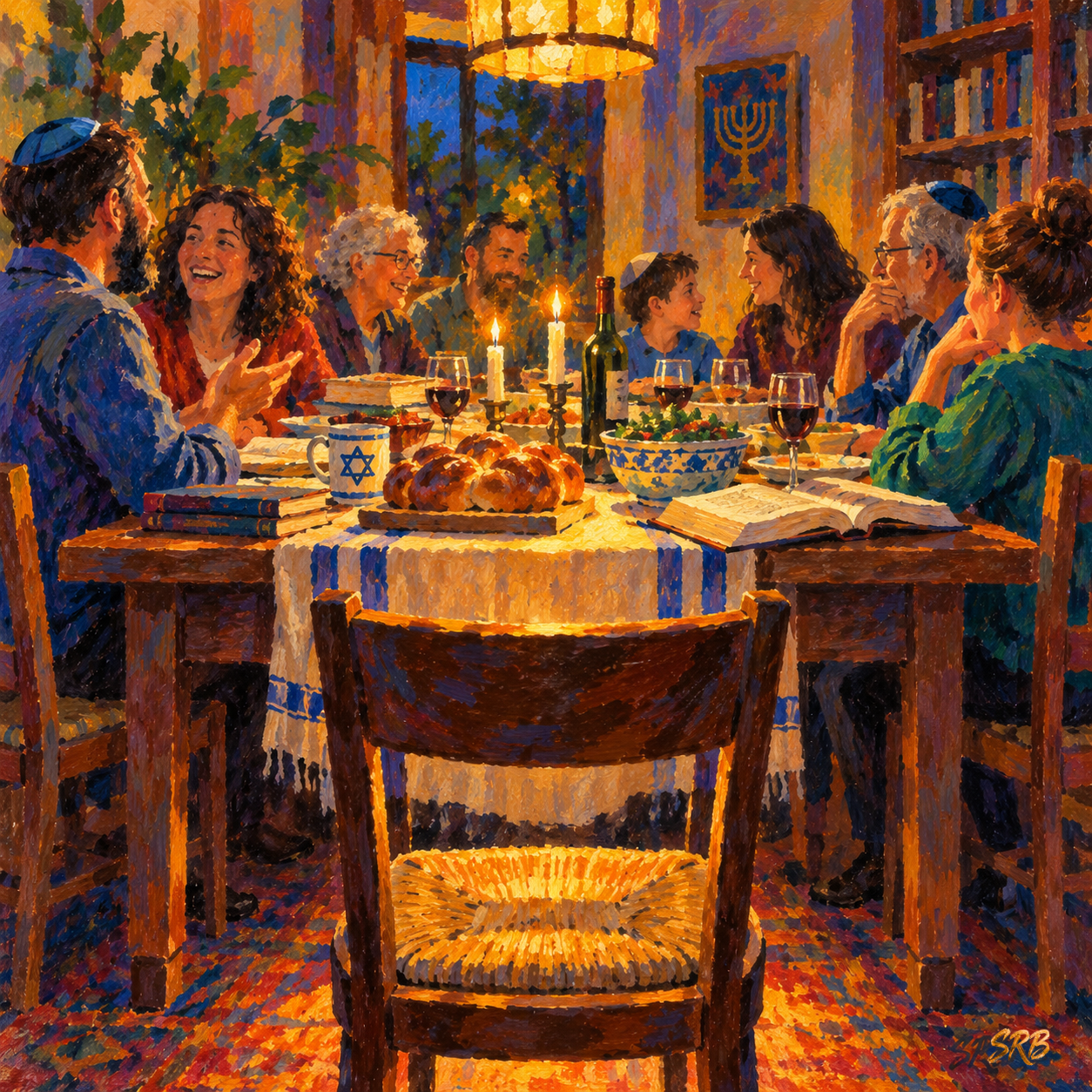
But there is also something that happens when another human being is sitting across the table from you. When someone knows your story. When someone disagrees with you. When someone sings beside you. When someone sits beside you when you are dying. When someone irritates the hell out of you.
There is neshama there. Soul meeting soul. No screen can completely reproduce it. And Judaism has always happened there. Between people.
Which means something else is true. Judaism needs you too.
I don't mean that as institutional guilt. I don't mean that Beth Israel needs another person in a chair so that we can report a larger attendance number. I mean:
Judaism needs Jews. It is a living tradition. And living traditions require living people.
Judaism needs your presence. It needs your questions. It needs your interpretation. It needs the way you wrestle with Torah. It needs the things you accept and the things you cannot accept. It needs what happens when your particular life encounters an ancient inheritance. It needs what you will teach the next generation. It needs what the next generation will learn from you without your even realizing that you taught it.
A tradition can be preserved on a shelf. It can be catalogued. Translated. Studied. Archived. But that is different from being alive.
We do not merely preserve Judaism. We inhabit it. We live inside it. And every generation changes the conversation simply by entering it.
That means Judaism misses you. Not because Judaism is keeping attendance. Because there is something that only happens when you bring your life into contact with it.
And perhaps you miss Judaism too. Not because you are deficient. Not because you are not Jewish enough. Not because you owe an institution more of your time. But because there may be something in your own inheritance that you have never opened. A text you have never encountered. A practice you have never tried. A question you did not know Jews had been asking for two thousand years. A Jewish friend you have not met.
There is an inheritance here that might help you live. You deserve to know what's in it.
And that requires something from us. We have to know our own tradition well enough that other people do not get to define it for us.
Because everybody has an opinion about what Jews are supposed to believe. Christians have told us what Judaism supposedly believes. American culture has told us which parts of being Jewish should remain private and which parts are acceptable in public. Politicians have told us what Jews should care about and how Jews should vote. People arguing about Israel have told us what a good Jew must believe about Israel. Antisemites have been telling us who we are for centuries. And sometimes our own families, our own synagogues, and our own rabbis have done it too.
But Judaism does not belong to any of them. It belongs to us.
And that does not mean Judaism is whatever we decide we want it to be. Judaism existed before us. It has its own texts. Its own history. Its own practices. Its own languages. Its own arguments. Its own theologies. Its own accumulated wisdom. Its own accumulated mistakes. We inherit all of it.
Jewish self-possession does not mean inventing a Judaism that agrees with everything I already think. It means knowing my inheritance well enough to wrestle with it for myself.
Know the Judaism you don't believe in.
We already tend to know the Judaism we do believe in. It is remarkably easy to build a Judaism that agrees with us.
The harder work is knowing enough to say: I know what this tradition teaches here. I understand why Jews have believed this. I know the argument. I have listened to people who understand it differently from me. And I still disagree.
That is wrestling. Jacob wrestles through the night and receives the name Yisrael. Israel. We are named for wrestling.
A people that does not know its own story will eventually allow someone else to tell it for them.
So know enough Judaism that when someone tells you, “Judaism says...” you can ask: Does it?
And perhaps some of us hear all of this and think: I tried. I came. And I was hurt.
If you were excluded from a synagogue, I am sorry. You are seen.
If your interfaith family was made to feel as though your family was somehow less beautiful or less worthy, I am sorry. Your family is beautiful the way it is.
If you are queer and a Jewish community made you feel that there was no place for you, you are b'tzelem Elohim. You are the image of God. And we love you.
If you don't believe in God—some days neither do I. If you find services boring—sometimes so do I. Help me figure out what would engage you.
And if another Jew wounded you badly enough that walking away seemed safer than staying—I understand. Sometimes leaving is exactly what we need to do. Sometimes a boundary is holy. Sometimes returning to the place that hurt us would not be teshuvah at all.
But the person who hurt you does not own your inheritance. The synagogue that failed you does not own your inheritance. The rabbi who disappointed you does not own your inheritance. No one gets to push you out of something that is yours.
Return does not have to mean coming back to this room. Maybe return means finding a few Jewish friends and having a drink. Maybe it means taking Hebrew. Maybe it means studying Torah online. Maybe it means hanging a mezuzah. Maybe it means making challah. Maybe it means mahjong. Maybe it means sitting beside another Jew who needs you. Maybe it means coming to services. I would love to see you.
But for too long, I think we have allowed ourselves to imagine that Jewish life and synagogue services are the same thing. They are not. Services are part of Jewish life. A beautiful part. An ancient part. An important part. But Judaism is a civilization to inhabit. And there are so many doors.
I am not asking you to come to synagogue more often. I am asking you not to miss the possibility of living some part of your Jewish life with other Jews.
Because maybe a year from now nothing dramatic will have happened. Maybe you will not have become a Torah scholar. Maybe you will not speak Hebrew. Maybe you will not suddenly love every prayer. Maybe all you will have done is put a mezuzah on your door and have a few conversations over beers.
But perhaps somewhere along the way you will discover: I love wrestling with this. I love knowing where I came from. I love these people even when they drive me crazy. I love that there are words for experiences I thought I was having alone. I love my Jewish heritage. And I don't want to be Jewish alone anymore.
My friends, I think we have made a mistake when we assume that the wisdom we need to live our lives will always be found somewhere outside our own tradition. We have made a mistake when we stop turning toward our own inheritance for questions our people have been wrestling with for generations. We have made a mistake when we allow other people to define Judaism for us because we have never learned enough Judaism to answer them.
So this year, I want us to take our Judaism seriously. Not grimly. Not unquestioningly. Seriously.
Know the Judaism you don't believe in so that you can better know the Judaism you do.
Learn something. Try something. Argue with something. Find another Jew. Let another Jew find you. Bring your questions. Bring your doubts. Bring the parts of Judaism you love. Bring the parts you cannot stand.
You do not have to become someone else's version of a good Jew. You do not have to believe what I believe. You do not have to agree with one another. But don't leave your inheritance unopened.
Open it. Read it. Argue with it. Live with it. Find what is yours within it. And then find somebody else to live some part of it with.
We began these Days of Awe by waking up. We remembered that our lives matter. We turned. Last night, we looked honestly at what the light revealed. And this morning, perhaps we can finally see something else: We were never standing there alone.
There have always been people beside us. There were people before us. God willing, there will be people after us. And somewhere among them is our place.
Not because we all agree. Not because we all practice the same way. Not because we all believe the same things. But because this story is ours. This inheritance is ours. These people are ours. And we are theirs.
Judaism misses you. And perhaps, somewhere inside you, you miss Judaism too.
Come home. Not to a Judaism someone else has chosen for you. Not to a Judaism you have invented from nothing. Come home to your place within this inheritance. Whatever that place needs to look like for you.
But come home.