

Delivered by Student Rabbi Ben Russell on Erev Shabbat Vayishlach 5787
Last week, we left Jacob back with his uncle Laban in Charran.
This week, in Vayishlach, we have a chance to look at whether Jacob's experiences with Laban might have helped him understand something about the pain he had caused his brother back in Parashat Toldot.
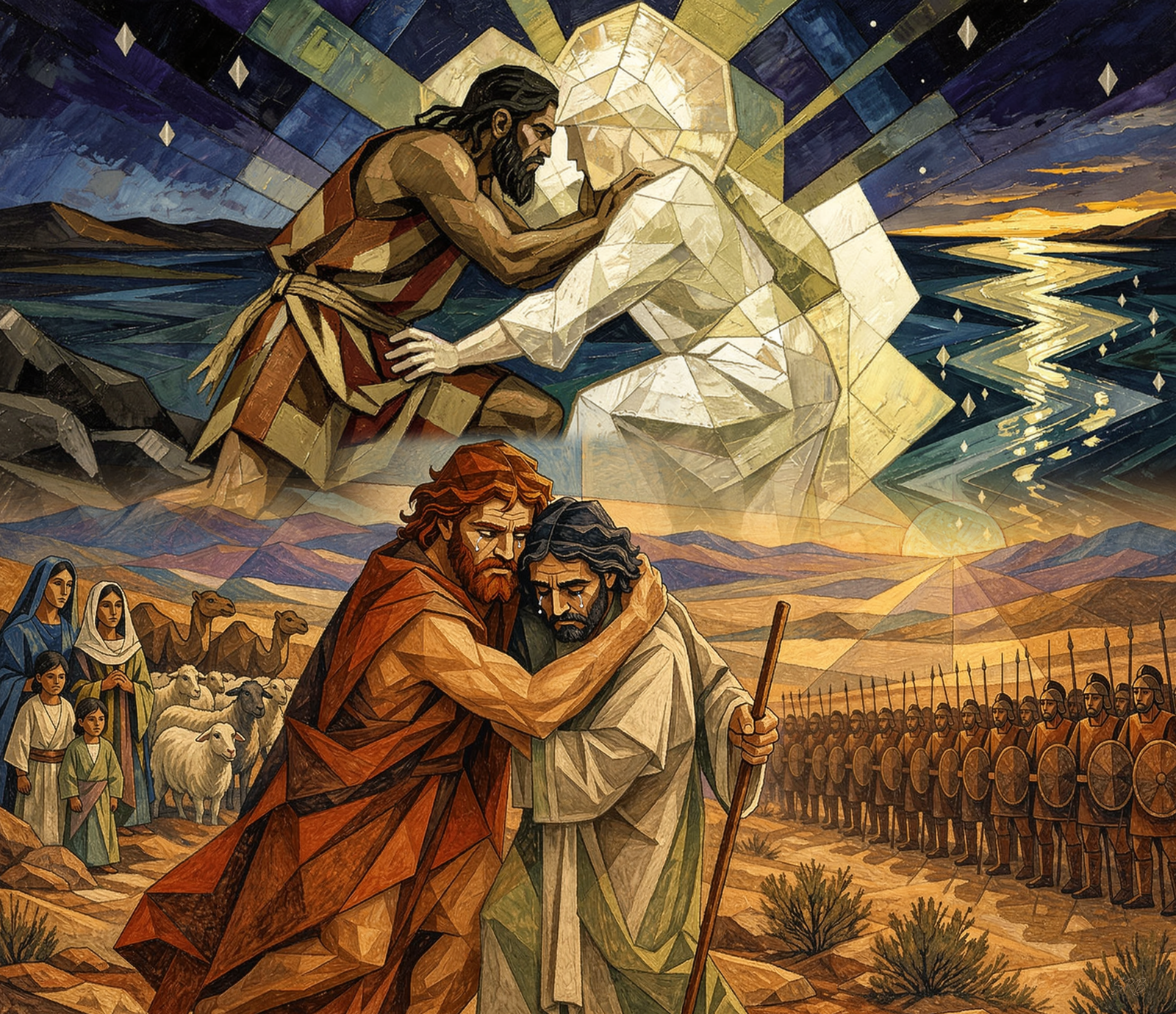
After twenty years, Jacob is finally going to encounter his brother again. And he's terrified.
He knows who his brother was, but Jacob has no idea who his brother has become over these years. When he learns that Esau is coming to meet him with four hundred men, well, you can imagine what must be going through Jacob's mind.
So, he begins sending gifts ahead of him, hoping to find favor with Esau.
One night, we find Jacob alone, wrestling with a mysterious figure.
And when that figure asks Jacob to let him go, what does Jacob say?
“I will not let you go unless you bless me.” (Genesis 32:27)
Now, there's something almost painfully familiar about this.
Think about how much of Jacob's life has been spent trying to get a blessing. He deceived his father to get one. At Bethel, even after God had unconditionally promised to protect him, Jacob struck a bargain. And now he's quite literally wrestling for one.
How often do we exhaust ourselves trying to secure something that might have come to us without all the struggling?
And he gets his blessing. But he walks away limping.
And I wonder how much of our own lives we spend doing exactly that. How often do we exhaust ourselves trying to secure something that might have come to us without all the struggling?
We don't know whether Jacob would have received that blessing had he not wrestled for it. But we do have evidence of what happens when he sees his brother.
Who ran? It wasn't Jacob. It was Esau.
Jacob bows before Esau seven times. And Esau runs toward Jacob. Esau throws his arms around his brother, kisses him, and the two of them weep.
Who ran? It wasn't Jacob. It was Esau.
We’ve been wondering how Jacob has grown over these twenty years. But what about Esau?
We don't know what Esau has been wrestling with. We don't know what his life has been like. And quite frankly, we don't need to know. Because we get to witness something of the person he has become.
But before Jacob ever finds those words, Esau has his arms around him.
And what's particularly interesting is that Jacob hasn't even apologized. He hasn't said, “Esau, I'm sorry for what I did to you.”
And while I think there is evidence that Jacob is genuinely sorry for what happened between them, there is a difference between being sorry for what happened and being sorry for what we did.
But before Jacob ever finds those words, Esau has his arms around him.
Does that mean that Esau no longer carries any of the pain of what happened twenty years ago? I doubt it.
And it certainly doesn't mean that their relationship is going to return to what it once was.
Relationships are living things. A tree cannot go back to being a sapling. And these two brothers cannot go back to being the people they were twenty years ago.
In fact, they'll go their separate ways after this encounter.
Our tradition doesn't ask us to stop being human. It asks us to sanctify our humanity.
But perhaps what Esau has discovered is that forgiveness is not a reflection of the worthiness of the person who has wronged us, but an expression of who we have chosen to become.
Our tradition doesn't ask us to stop being human. It asks us to sanctify our humanity.
And Jacob catches a glimpse of what that looks like in his brother when he says:
Ra'iti fanecha kir'ot p'nei Elohim.
“I have seen your face as one sees the face of God.” (Genesis 33:10)
Just hours earlier, Jacob named the place where he had wrestled through the night Peni-El—the Face of God, because, in his words, he had seen God face to face.
And now he's looking at Esau and saying almost the same thing.
Our rabbis have long suggested that there is a connection between the figure Jacob wrestled with that night and Esau.
We may never know exactly who Jacob wrestled with that night, but I wonder whether something suddenly clicks for Jacob when he sees his brother.
Perhaps he's beginning to understand something about God that he didn't understand the night before.
He's receiving something he hasn't earned.
Because here Jacob is experiencing grace. He's experiencing loving-kindness. In the arms of his brother, he is experiencing mercy.
Chein, v’chesed, v’rachamim.
He's receiving something he hasn't earned. And for once in his life, he hasn't had to wrestle anyone to get it.
And perhaps Jacob is finally beginning to get it.
Because when he finally persuades Esau to accept his gift, notice what he says:
Kach na et birchati.
“Please accept my blessing.” (Genesis 33:11)
My blessing!
Do you remember what Esau asked his father twenty years ago?
“Have you but one blessing, my father?” (Genesis 27:38)
Now, here stands Jacob, the brother who took that blessing, offering a blessing to Esau.
And for the first time in this story of two brothers competing for a blessing, there seems to be enough blessing for both of them.
Esau tells Jacob that he has plenty. Jacob tells Esau that he has everything.
And for the first time in this story of two brothers competing for a blessing, there seems to be enough blessing for both of them.
Yet, perhaps one of the greatest blessings of Jacob’s life is the one that comes running toward him.
Learning not only how to receive a blessing, but how to become one.
And I wonder how many blessings we might discover in our own lives if we weren't so busy wrestling for them. And how many blessings we might bring into the lives of others if we really believed there was enough blessing for all of us.
Perhaps that's part of the work of becoming. Learning not only how to receive a blessing, but how to become one.
,שבת שלום
Student Rabbi Ben