

Delivered by Student Rabbi Ben Russell on Erev Shabbat Vayetzei 5787
Over these past several weeks, we've spent a great deal of time talking about relationships. We've explored what happens when anger comes between brothers, when love makes us vulnerable, when silence leaves questions unanswered, and when favoritism turns affection into competition.
And along the way, we've asked some difficult questions about how we treat one another.
What happens when the person who hurts us reminds us of ourselves?
But this week, our Torah portion asks us to consider something a little different.
What happens when the person who hurts us reminds us of ourselves?
What happens when the behavior we find so objectionable in someone else is the very behavior we've struggled to recognize in our own lives?
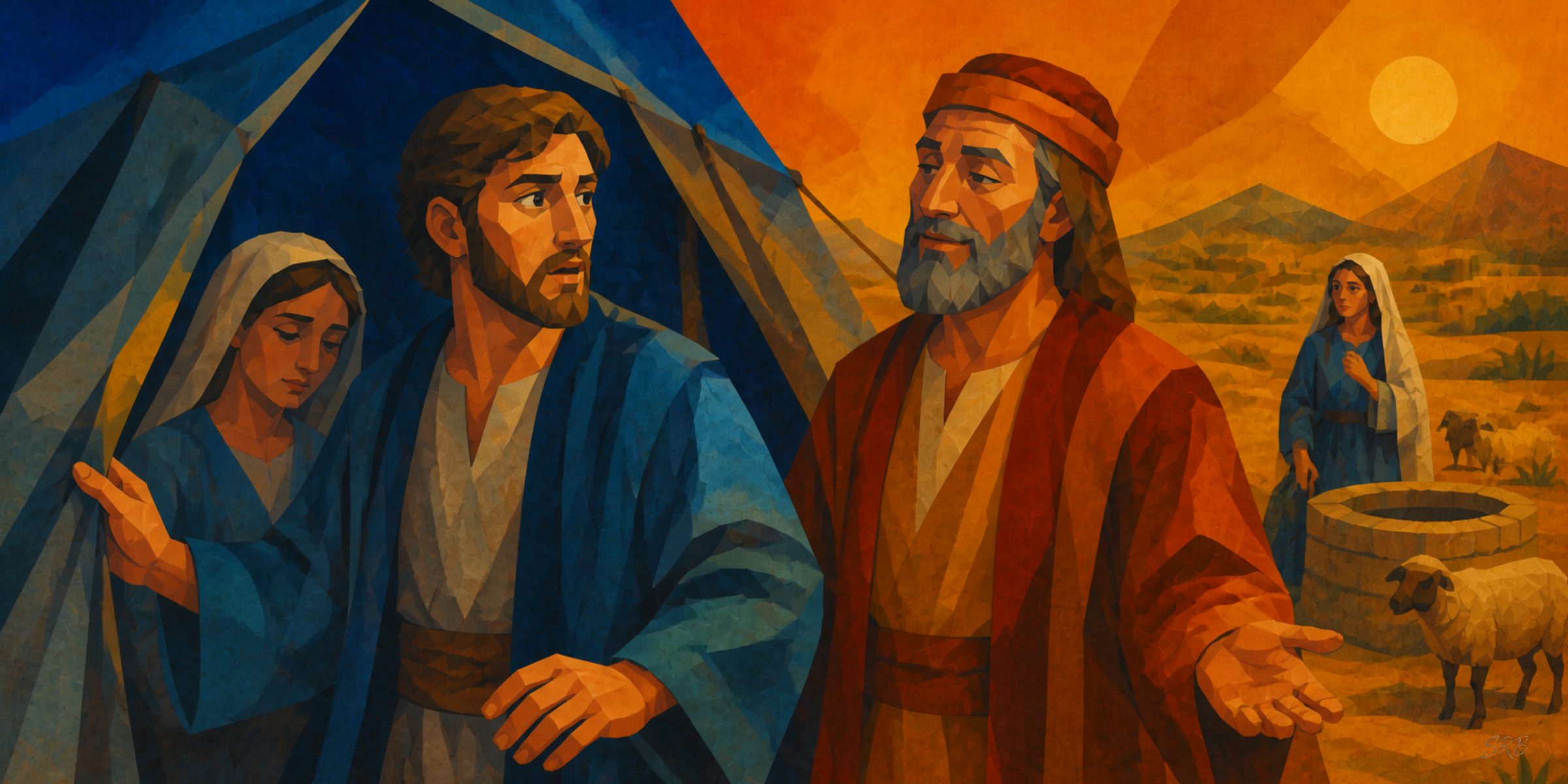
This week, Jacob encounters a man named Laban. And whether Jacob realizes it or not, he may be looking into a mirror.
Remember where we left Jacob last week.
He had deceived his father by pretending to be his older brother, Esau. With his mother's help, he received the blessing Isaac had intended for Esau.
And when Esau discovered what had happened, he was furious. So furious that Jacob had to flee.
Now, at this point in the story, Jacob has arrived in the household of his uncle Laban. He falls in love with Laban's daughter Rachel and agrees to work seven years in exchange for her hand in marriage.
And the Torah tells us that those seven years seemed like only a few days because of his love for her.
But when the wedding night arrives, Laban substitutes his older daughter, Leah, for Rachel. And somehow, Jacob doesn't discover the deception until morning.
Imagine what he must have felt.
Seven years of work. Seven years of anticipation. Seven years of imagining a life with the one he loved. And now, the shock of discovering that the person he trusted has deceived him.
Jacob confronts Laban.
Mah zot asita li?
"What is this you have done to me?" (Genesis 29:25)
And Laban offers an explanation.
"It is not done in our place…
lateit hatz'irah lifnei hab'chirah
…to give the younger before the firstborn." (Genesis 29:26)
Of all the things Laban could have said to Jacob! The man who disguised himself as his older brother to receive a blessing is now being told that the younger cannot come before the older.
The deceiver has been deceived. And the irony could hardly be more pointed.
Why is it sometimes so much easier to recognize wrongdoing when someone else is doing it?
The Torah never tells us whether Jacob recognizes that irony. But we do.
And that raises an uncomfortable question. Why is it sometimes so much easier to recognize wrongdoing when someone else is doing it?
Think about how we explain our own behavior.
When we lose our patience, we know how exhausted we were. When we say something hurtful, we know what we were trying to communicate. When we make a questionable decision, we know all the circumstances that led us there.
We know our intentions. We know our fears. We know our reasons.
But when someone else does something similar? We see what they did. And we wonder how they could possibly think it was acceptable.
Now, sometimes our circumstances really are different. Sometimes our reasons matter enormously. But having an explanation for our behavior doesn't necessarily mean that our behavior was right.
But having an explanation for our behavior doesn't necessarily mean that our behavior was right.
Jacob had his own reason for deceiving Isaac. Laban had another for deceiving Jacob. But neither reason erases the harm that was done in both cases.
And here's what I find most interesting about this story.
Jacob has every right to be angry with Laban. He was deceived. He was exploited. An agreement was broken.
Jacob can be genuinely wronged and still have something to learn about himself.
We should not minimize that injustice merely because Jacob has deceived someone before.
Jacob can be genuinely wronged and still have something to learn about himself. Jacob can be a deceiver and still deserve to be treated with dignity. Those truths can exist together.
But imagine, for a moment, that Jacob does recognize himself in Laban. Imagine that somewhere in his outrage, he remembers standing before his father, pretending to be someone he wasn't.
What would that realization do to him? Would it make him less angry with Laban?
Perhaps not. And perhaps it shouldn't. But might it change the way he remembers what he did to Esau?
Because there's a difference between knowing that we've hurt someone and recognizing what it felt like to be hurt by us.
Might he begin to understand something about his brother's anguish that he couldn't understand before?
Because there's a difference between knowing that we've hurt someone and recognizing what it felt like to be hurt by us. And sometimes that recognition is deeply uncomfortable.
We like to believe that we're different from the people who have hurt us. That we would never do what they did. That even when we've made mistakes, our circumstances were different. Our intentions were better. Our reasons were understandable.
And sometimes they were.
That's a difficult mirror to look into.
But what happens when we recognize that the distinction we've been relying on isn't quite as clear as we thought? What happens when we discover that someone else might be telling a story about us that sounds frighteningly similar to the one we're telling about those who hurt us?
That's a difficult mirror to look into. And we don't know whether Jacob ever looked into it.
But we do know that Jacob's story continues. Years later, he will return to face Esau.
And the man who once approached his father in disguise will approach his brother openly, afraid of what that encounter might bring. He will bow before Esau. He will offer him gifts. And he will seek a welcome from the brother whose blessing he once took.
We cannot know how much of that change began in Laban's household. But we can appreciate that the experiences of those intervening years may have helped Jacob become someone capable of approaching his brother differently.
Because when the mirror turns toward us, we have a choice.
Perhaps that's one of the most difficult parts of the work of becoming. Not simply recognizing that we've made mistakes. But allowing what we've experienced at the hands of others to change how we understand the mistakes we've made ourselves.
Because when the mirror turns toward us, we have a choice.
We can spend our energy explaining why we're different from the person whose behavior has hurt us. Or we can ask what their behavior has revealed about our own.
And perhaps the most important question isn't whether we like the person we see in that mirror. It's whether we're willing to let what we see change the person we are becoming.
,שבת שלום
Student Rabbi Ben