

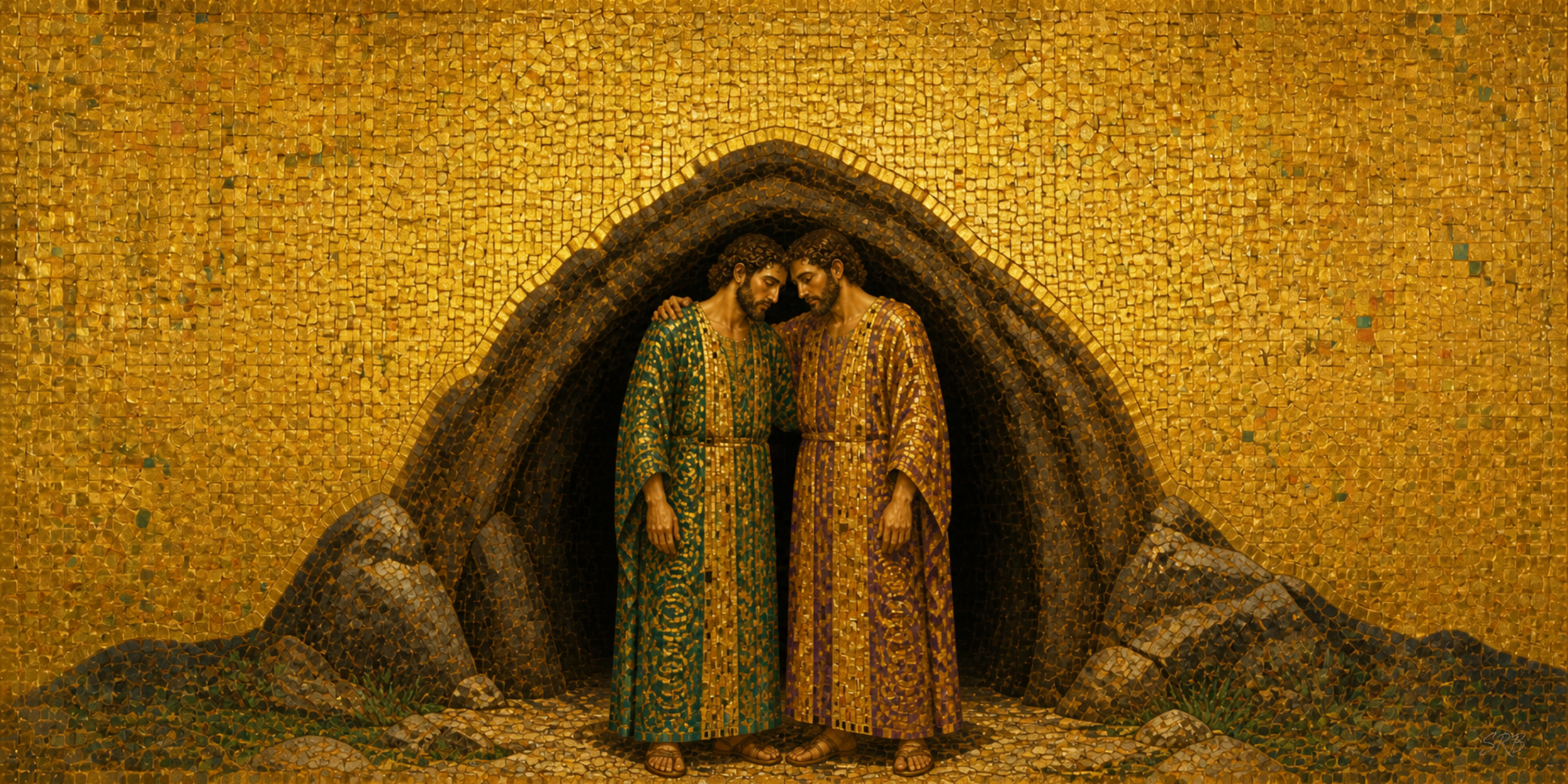
Delivered by Student Rabbi Ben Russell on Erev Shabbat Chayei Sarah 5787
If you're comfortable, I'd like to invite you to close your eyes for a moment.
Imagine a burial scene. A father has died after a long and fulfilling life. His family has gathered to lay him to rest.
And standing there are two brothers. They have the same father, but their lives have been very different.
One grew up with a place in his father's household. The other was sent away. One inherited the family covenant. The other had to make a life out in the world beyond that household.
They have a history together. A very complicated one.
And yet, here they are. Standing together at their father's grave.
The Torah gives us just one sentence:
Vayikberu oto Yitzchak v'Yishma'el banav.
“His sons Isaac and Ishmael buried him.” (Genesis 25:9)
That's it. No conversation. No explanation. No account of what either brother was feeling. Just two brothers, burying their father.
And I wonder:
What journey brought them here?
Go ahead and open your eyes.
We know quite a bit about how this family's story began. Ishmael was Abraham's firstborn. A son born to Hagar, who was a servant enslaved in Abraham and Sarah's household.
Then Isaac was born. Eventually, Sarah demanded that Hagar and Ishmael be sent away.
Now the Torah tells us Abraham was distressed by this. But he sent them away. And Hagar and Ishmael found themselves in the wilderness, running out of water, facing the possibility of death.
Two sons. The same father. Very different experiences of belonging.
Isaac, however, remained in Abraham's household.
Two sons. The same father. Very different experiences of belonging.
And then, years later, the Torah gives us that single sentence.
His sons Isaac and Ishmael buried him.
How did they get there? Well, the rabbis wondered about that, too.
They knew the painful history of this family. And they, like us, were troubled by some of the things they saw. And what do we do when a part of the Torah troubles us? We go back and read it again.
We look for something we might have missed. So did the rabbis, and they noticed something interesting.
When the Torah names the brothers, it doesn't say Ishmael and Isaac. It says Isaac and Ishmael. But Ishmael was the older brother.
In the Talmud, Bava Batra 16b, the rabbis understand that ordering as evidence that Ishmael had undergone teshuvah during Abraham's lifetime. He had changed. He was willing to give his younger brother precedence.
Now, that's the rabbis' interpretation. The Torah itself doesn't explain the order. But the rabbis saw something there and they latched onto it.
And there's another interesting clue. Earlier in this very Torah portion, just before Isaac meets Rebekah, the Torah places him near Be'er Lachai Ro'i. That's the well associated with Hagar's encounter with God.
Years earlier, when Hagar fled into the wilderness, she encountered the God who saw her suffering. She called God El Ro'i—"the God who sees me."
And now, all these years later, Isaac appears near that same place. After Abraham's death, the Torah tells us Isaac settles there.
Rashi, drawing on an earlier midrashic tradition, imagines that Isaac had gone there to bring Hagar back to Abraham. The Torah doesn't tell us that happened.
Perhaps Ishmael wasn't the only one changing.
But isn't it interesting that the rabbis imagined Isaac taking a step toward restoring something that had been broken in his father's household?
Perhaps Ishmael wasn't the only one changing. Perhaps Isaac was finding his own way toward something different. And perhaps, by the time the brothers stood together at Abraham's grave, a journey had already been underway for years.
We don't know. But I find that possibility deeply moving.
Because think about what these brothers would have had to overcome. They didn't experience Abraham in the same way. They didn't experience their childhoods in the same way. And they certainly didn't inherit the same future.
Yet somehow, they came to a place where they could stand together and honor their father.
And that makes me think about families today. Imagine two children growing up in the same household. One remembers a father who was warm and affectionate. The other remembers a father who was distant, critical, or simply unavailable.
But what if they're both telling the truth?
And when those children grow up, they sometimes find themselves arguing about who their father really was.
But what if they're both telling the truth? What if one child genuinely experienced that love, and the other genuinely experienced its absence?
The first child doesn't have to apologize for being loved. And the second doesn't have to pretend that love was there when it wasn't.
Neither one can take away the love the other received. And neither one can give themselves the love they never experienced.
But they can recognize that their experiences were different. And they can allow both experiences to be true.
I think that's one of the things Torah is constantly asking of us. To become people who can genuinely recognize that someone else may experience the world very differently than we do—and not feel threatened by it.
Because this doesn't happen only between siblings. It happens between friends. Between spouses. Between generations. Even within congregations.
Two people can experience the same relationship, the same event, or the same community very differently. And sometimes our first instinct is to defend our own experience rather than listen to theirs.
We hear someone describe something painful, and immediately we want to explain why it wasn't that bad. Or why we didn't see it that way. Or why they must have misunderstood.
We can feel sorrow for what someone experienced without feeling guilty for the good we've received.
But acknowledging another person's suffering doesn't mean we're accepting blame for causing it. That's a false choice.
We can recognize that someone was hurt without being responsible for the hurt. We can feel sorrow for what someone experienced without feeling guilty for the good we've received.
And when that recognition begins to change how we treat one another, compassion becomes something more. It becomes responsibility.
Sometimes the person who caused the hurt never apologizes. Sometimes they never understand what they did. Sometimes they die before the conversation can happen. And the next generation is left with the consequences.
But I believe an apology can still matter, even when it comes from someone who didn't cause the original harm. Sometimes someone can say:
“I know what happened to you. I know it wasn't right. I didn't make that choice, but I'm sorry you suffered because of it.”
That apology cannot undo the past. It cannot replace the apology that was owed. But it can tell someone something they may have waited a lifetime to hear:
I see what happened to you. And I'm not going to pretend it didn't happen.
Now, we don't know whether Isaac ever said anything like that to Ishmael. We don't know whether Ishmael ever told Isaac what those years had been like. We don't know whether the brothers forgave Abraham, or whether they ever fully reconciled with each other.
Not every relationship can be repaired. And not every relationship should be restored.
And we shouldn't pretend that we do.
Not every relationship can be repaired. And not every relationship should be restored. But the possibility of reconciliation remains something worth working toward when people are willing and able to do that work.
Perhaps it begins with a question. “What was that experience like for you?” And then listening without correcting the answer.
Perhaps it begins with an acknowledgment. “I know things were different for you than they were for me.”
Or perhaps it begins with an apology. Not because we are guilty of everything that happened before us, but because we care about what happens next.
Neither had to surrender his own story in order to stand beside the other.
And that brings me back to the two brothers standing at their father's grave. Isaac and Ishmael. Two sons who had lived very different lives. Two sons who may have carried very different memories of the same father.
Neither had to pretend Abraham was perfect in order to honor him. Neither had to surrender his own story in order to stand beside the other.
And whatever journey brought them there, the Torah tells us that they buried their father together.
I wonder how many conversations we never heard. How many moments of recognition. How many small choices that made this one moment possible. How many honest fights.
We may never know. But perhaps that's what makes this little sentence so powerful.
We cannot change the history we share. But we can change how we carry it together.
Because sometimes we see two people standing together, and we have no idea how much work it took for them to get there.
And sometimes the most important work of becoming is learning to make room for someone else's story alongside our own.
We cannot change the history we share. But we can change how we carry it together.
And perhaps the question for us tonight isn't whether we can repair every relationship in our lives. Perhaps it's something smaller. Something we can begin today.
What journey might become possible if we were willing to take the first step?
,שבת שלום
Student Rabbi Ben