Delivered by Student Rabbi Ben Russell on Erev Shabbat Vayera 5787
A few weeks ago, we met Noah. The Torah described him as righteous in his generation. When God announced that the world would be destroyed, Noah built the ark, just as he was commanded. And the Torah records no objection.
We don't know why. Perhaps Noah was overwhelmed. Perhaps he was afraid. Perhaps he couldn't imagine what anyone might say in the face of something so enormous. The Torah simply doesn't tell us.
Last week, we met Abram. God told him to leave his homeland, his birthplace, and his father's household. And Abram went.
But as the journey unfolded, we began to hear something new in the conversations between Abram and God. At first, there were promises. Then there were experiences. Dangers. Uncertainties. Years passing without the future Abram had been promised becoming any clearer. And eventually, Abram began asking questions.
Mah titen li, v'anochi holech ariri?
“What will You give me, seeing that I remain childless?” (Genesis 15:2)
And later:
Bamah eda ki irashenah?
“How shall I know that I will possess it?” (Genesis 15:8)
There is something wonderfully human about those questions.
Trust hasn't made the uncertainty disappear. It has given him a relationship in which he can speak about it.
Abram has already left everything familiar behind. He has trusted God enough to build his life around a promise. And still, he wants to know.
Trust hasn't made the uncertainty disappear. It has given him a relationship in which he can speak about it.
And this week, something changes again. God is preparing to investigate the outcry against Sodom and Gomorrah. The accusations against these cities are grave. But before God proceeds, we hear God ask:
Ham'chaseh ani me'Avraham asher ani oseh?
“Shall I conceal from Abraham what I am about to do?” (Genesis 18:17)
It's such a beautiful question. Because God could have said nothing. God doesn't need Abraham's permission. God doesn't need to consult him.
And yet, the Torah allows us to overhear God considering whether Abraham should be brought into the conversation. And immediately afterward, we're reminded why Abraham was chosen: to teach his household to follow the way of the Eternal, doing what is righteous and just.
Tz'dakah umish'pat.
Righteousness and justice.
Those are not simply admirable qualities Abraham is supposed to possess. They're part of what his relationship with God is supposed to cultivate.
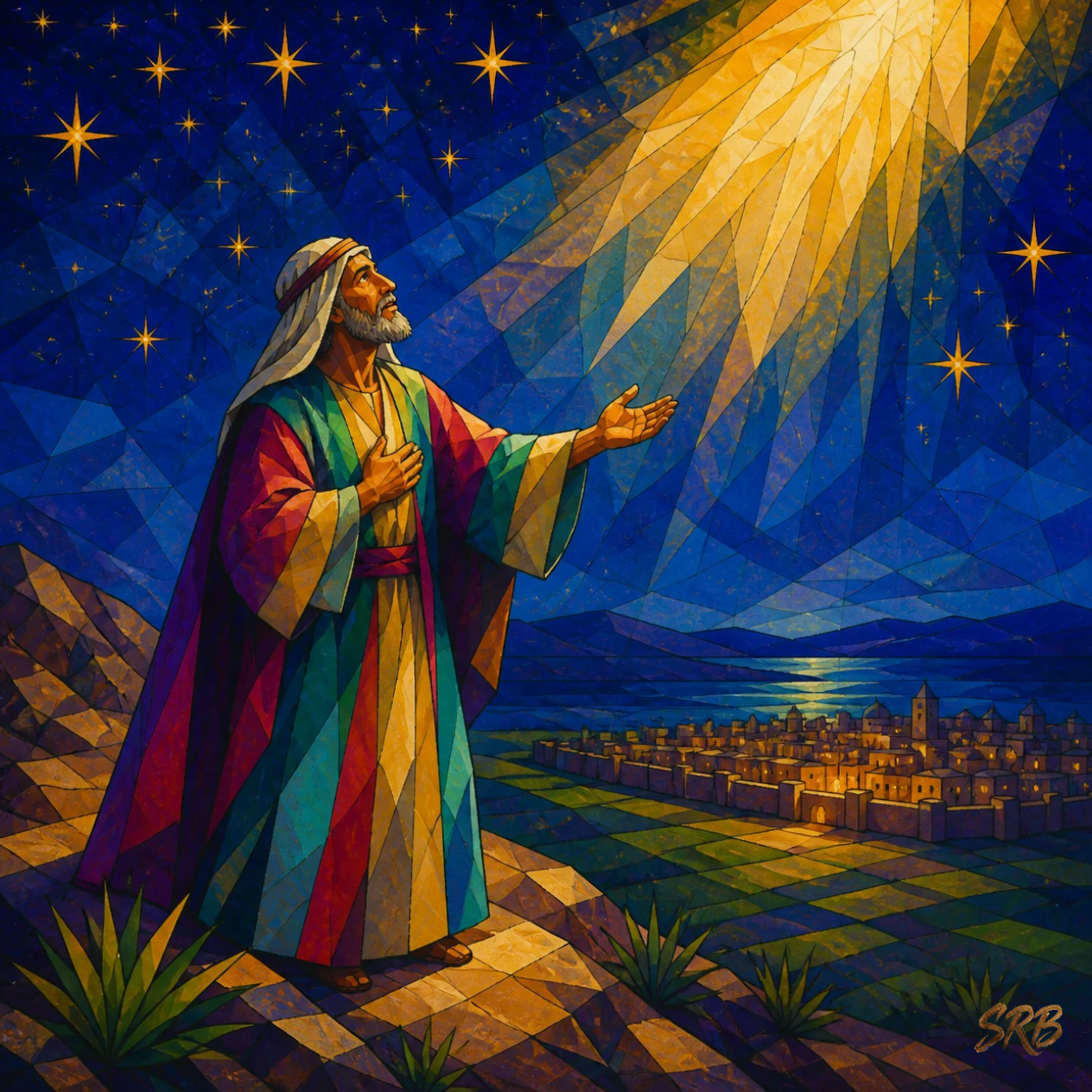
And now, almost as though the Torah is asking us to watch what happens, Abraham is confronted with a question of justice. God tells him about the outcry against Sodom and Gomorrah.
Abraham could simply accept what he hears. After all, he knows whom he's speaking to. But instead, he steps forward.
Ha'af tis'peh tzaddik im rasha?
“Will You indeed sweep away the righteous with the wicked?” (Genesis 18:23)
And then comes the question that is breathtaking.
Hashofet kol ha'aretz lo ya'aseh mish'pat?
“Shall the Judge of all the earth not do justice?” (Genesis 18:25)
Think about the nerve that takes. Abraham is asking God whether God is about to act unjustly. And he isn't doing it to secure another promise for himself. He's doing it for people in a city he doesn't even live in.
But look closely at what he asks. Suppose there are fifty righteous people in Sodom. Would God spare the city?
Not just the fifty. The city. Everyone. Including the people whose wrongdoing has brought the city to this moment.
That's a much more difficult request than it first appears. Abraham begins with a question about justice: surely the innocent shouldn't be destroyed alongside the guilty. But then he asks for something justice alone might not require. He asks that the guilty be spared, too.
Not because their actions don't matter. Not because the suffering they've caused should be ignored. But because the presence of righteousness might be reason enough to give an entire community another chance.
Abraham is asking God to make room for mercy.
Abraham is asking God to make room for mercy. And God agrees. For fifty righteous people, the city will be spared.
Now, if I were Abraham, I suspect I might be inclined to stop there. I've just challenged the Judge of all the earth, and the Judge has agreed with me. That seems like a good moment to say thank you and quietly make an exit.
But Abraham keeps going. What about forty-five? God agrees. Forty? Yes. Thirty? Twenty? And finally:
Ulai yimatz'un sham asarah.
“Perhaps ten will be found there.” (Genesis 18:32)
Ten. An entire city hangs in the balance, and Abraham is asking whether ten righteous people might be enough. And God says yes. Then Abraham stops.
Why ten? The Torah doesn't tell us. Maybe Abraham thought there must surely be ten. Maybe he couldn't bring himself to ask for any fewer. Maybe there was something about ten that seemed to him like the smallest possible presence of righteousness within a community. We don't know.
But consider what has happened in this conversation. The fate of an entire city has come to rest, at least in Abraham's question, upon the lives of a handful of people. Not people with extraordinary authority. Not necessarily people anyone would have recognized as important. Just people whose lives were marked by righteousness.
What can a few people change about the character of a community?
And I wonder what that means. What can a few people change about the character of a community? How much difference can they make simply through the way they live, the way they treat others, the things they refuse to accept as normal? And what happens to a community when even ten becomes difficult to find?
Abraham doesn't answer those questions. He stops at ten. And the conversation ends.
But there's another detail worth coming back to. In the middle of this extraordinary negotiation, Abraham says:
V'anochi afar va'efer.
“I am but dust and ashes.” (Genesis 18:27)
Dust and ashes. It's an astonishing thing to say in the middle of challenging God. Abraham knows exactly how small he is in this conversation. He isn't confused about the difference between himself and the One he's addressing. And yet, knowing that doesn't make him retreat.
He can speak humbly without speaking timidly.
In fact, he seems able to hold both things at once. He can recognize God's greatness without surrendering his concern for justice. He can speak humbly without speaking timidly. And perhaps most remarkably, he can disagree without treating the disagreement as a threat to the relationship.
I think we find in our daily experiences that is much harder than it sounds. We sometimes imagine that respect means either simply agreeing or keeping our objections to ourselves. Especially when the person across from us is someone we love, someone we admire, someone whose place in our lives matters deeply.
Because disagreement carries a risk. What if they misunderstand us? What if we discover that we see something important very differently? What if speaking changes the relationship?
Those aren't imaginary concerns. Sometimes it does.
And yet, there are moments when remaining silent carries a cost of its own. Not every disagreement needs to become a confrontation. And not every silence is a failure. But sometimes the very things that make a relationship meaningful are the things that make a difficult conversation necessary.
I find myself thinking about how Abraham arrived here. When we first met him, God spoke, and Abram, as we knew him then, went. Later, Abram began asking God questions about the future he had been promised. And now Abraham is asking questions about the future of people who have no particular claim upon him.
The circle of his concern has widened.
And I wonder whether that is one of the ways relationships change us. Not simply by making us feel understood or supported, important as those things are. But by making us more attentive to lives beyond our own. By teaching us to notice suffering we might once have overlooked. By giving us the courage to ask questions we might once have been afraid to ask.
Of course, Abraham himself is not a perfect example of any of this. We've already seen that his own relationships can be painfully complicated. And we'll see more of that before his story ends.
But perhaps that's part of what makes this moment so meaningful. The Torah doesn't give us a person who has finished becoming. It gives us someone still in the middle of it. Someone capable of remarkable moral courage, even while other parts of his life remain unresolved.
A few weeks ago, Cain asked, “Am I my brother's keeper?” Noah left us wondering about the meaning of silence. Abram taught us that trust can live alongside uncertainty. And now Abraham stands before God and asks whether an entire city might be spared for the sake of ten righteous people.
He doesn't know how the story will end. Neither do we, at this particular moment in the telling. But he knows enough to ask.
And perhaps that's where the work of becoming sometimes begins. Not with certainty that we're right. Not with the assurance that speaking will change anything. But with the recognition that something matters enough to bring into the conversation.
Justice matters. Mercy matters. The lives of people beyond our own circle matter.
People who have learned that love and respect need not end where disagreement begins.
And if the relationships we treasure are helping us recognize those things more clearly, perhaps they are doing something far greater than making our lives more comfortable. Perhaps they are helping us become people who can no longer look away so easily. People who have learned that love and respect need not end where disagreement begins. And people who, when something important is at stake, are willing to step forward and speak.
,שבת שלום
Student Rabbi Ben