
Turn
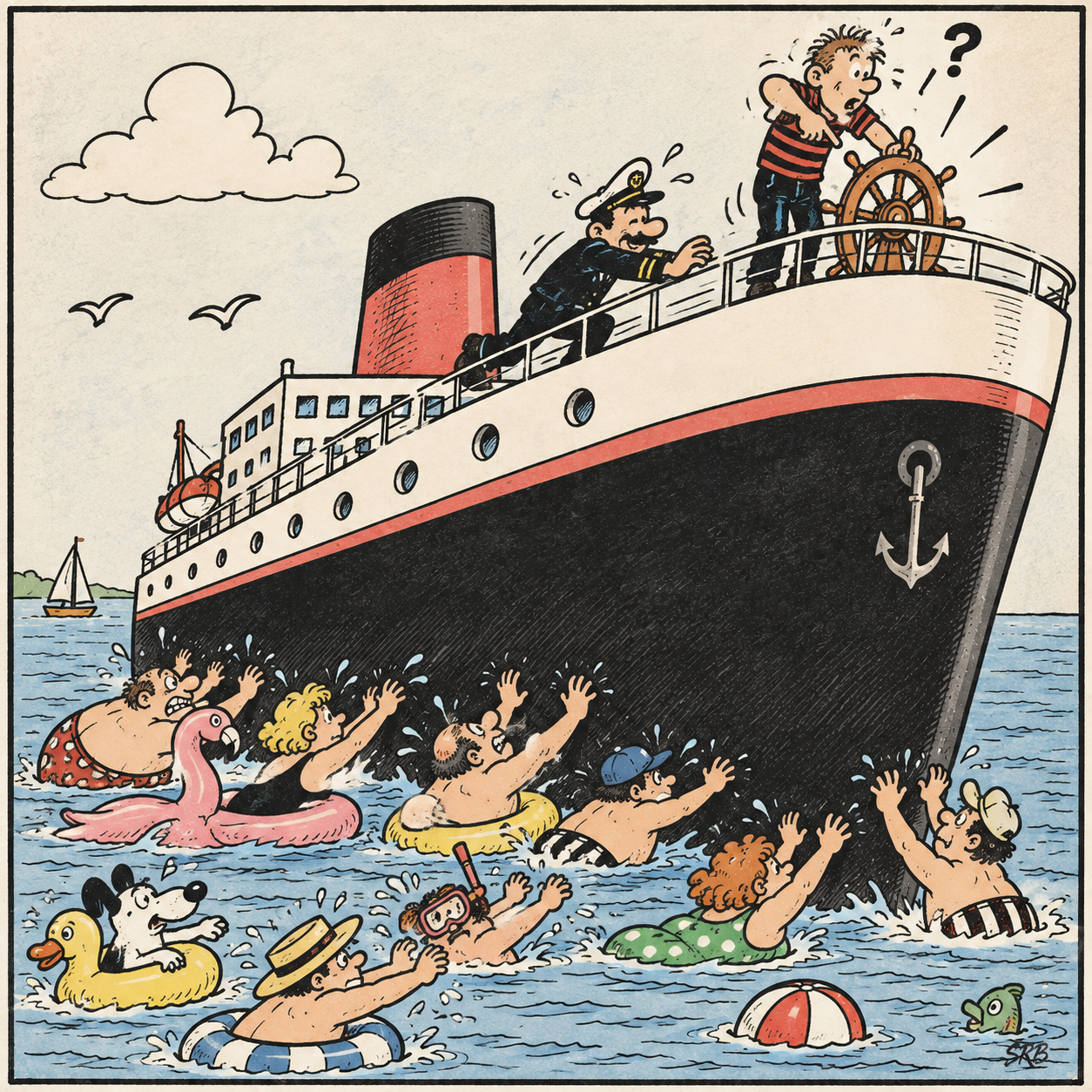
There is something almost absurd about imagining a ship sitting on dry land.
A great ship can weigh tens of thousands of tons. Standing beside it, you could push against the hull with every ounce of strength you have and accomplish absolutely nothing. You could gather more people. Push harder. Try again.
The ship would not move.
Sometimes I think this is how we imagine our lives when we think about teshuvah. We look at the enormous weight of a life—our habits, our relationships, our mistakes, our patterns, the things we wish we had done differently, the things we still want to change—and wonder: How am I supposed to move all of this?
And when the task feels impossibly large, sometimes we don't move at all.
But the image is wrong. The ship isn't sitting on land. It is already in the water. And so are we.
Our lives are already moving.
Time passes whether we pay attention to it or not. Relationships change. Habits deepen. Experiences accumulate. Choices ripple outward. Even when we think we are standing still, life continues moving around us and through us.
That means teshuvah does not require us to somehow pick up the entire ship of our lives and put it somewhere else.
We can turn the wheel. Maybe only a few degrees.
That does not mean turning is easy. Sometimes the smallest turn requires enormous courage.
It may mean noticing something about ourselves we would rather not notice. It may mean admitting that a relationship we love is moving in a direction we do not want it to go. It may mean changing a habit that has become comfortable. It may mean apologizing. It may mean making a boundary. It may mean finally acknowledging that the life we say we want and the life we are actually living are pointed in different directions.
None of that is necessarily easy. But it is accessible.
The wheel does not have to move dramatically for the ship to begin changing course. A small movement can begin the turn.
And at first, almost nothing seems different. The ship is still surrounded by the same water. It still carries the same cargo. The destination may still be impossibly far away.
But something has changed. The ship is no longer traveling exactly where it was traveling before.
Imagine two ships beginning beside one another. One continues straight ahead. The other changes its course by only a few degrees. At first, they remain close together. The difference is barely noticeable.
But they keep moving. A mile later, there is distance between them. Ten miles later, more. A hundred miles later, those few degrees have carried them toward very different places.
Our lives work something like that. The small choices accumulate.
A marriage has slowly become almost entirely about raising children. Nothing is necessarily falling apart. There has been no catastrophe. But two people begin to notice where they are headed. They realize that if they continue exactly as they are, someday the children may leave and they may look at one another and wonder: Who are you, and why are you in my house?
So they turn.
Maybe they start going on dates again. Maybe they let the children manage something without them. Maybe they deliberately make room for a relationship that had slowly been pushed to the edges.
None of those things transforms a marriage overnight. But the direction has changed.
And then they keep turning. That part matters.
Teshuvah is not making one tiny movement of the wheel and declaring the work finished. I have turned and I am now pointed in the direction I need to go are not always the same thing.
Sometimes we turn a little and then discover that we need to turn again. Sometimes we pause. Sometimes the next movement requires more courage than the first.
And when we have harmed someone, recognizing the harm is not the end of the work. The turn has to continue into what comes next: different choices, changed behavior, repair.
But we do not have to know how to complete the entire journey before we are allowed to begin it.
As long as we are breathing, there is time to turn.
Teshuvah is not confined to these days. But these are the days Judaism refuses to let us avoid looking at our course.
Perhaps that is part of the gift of these days between Rosh Hashanah and Yom Kippur. Judaism interrupts our lives and asks us to look at the direction in which we are moving.
Not simply:
Where do you hope to end up?
But:
Where are you actually headed?
And then comes the harder question:
Which way should we turn?
I am not sure there is one identical answer for every Jewish life.
Maybe finding the direction is a little like trying to find the sun with your eyes closed. You turn slightly. You notice. You turn again. And eventually you begin to feel warmth on your face.
Perhaps we recognize that warmth when we find ourselves moving closer to Torah. Closer to another person. Closer to God, however we understand God. Closer to our true selves.
And perhaps that true self is not simply another destination. Something within us begins to resonate when we find ourselves facing that metaphorical sun.
That does not necessarily mean closer to what is comfortable. Sometimes the turn that brings us closer to who we really are is difficult. Sometimes it asks something of us.
But something begins to resonate. Our hearts and souls begin to recognize that we are facing something toward which we want to keep moving.
And we will not all approach that warmth from the same place or at the same angle. One person's turn toward Torah may look different from another's. One person's turn toward another human being may require drawing closer. Another person's may require creating a boundary. One person's turn toward God may be prayer. Another person's may begin with an honest question.
The degrees will be different. The journeys will be different. But the turning is available to us.
We spend so much of our lives naming destinations.
I want to be more patient. I want a better marriage. I want to repair this relationship. I want a richer Jewish life. I want to pray. I want to take better care of myself. I want to become more fully who I am.
Those desires can be completely sincere. But until we change direction, the destination remains theoretical.
We do not have to arrive during these Ten Days. We do not have to move the entire ship. We may not even know exactly where the journey will take us.
But we can move the wheel. Teshuvah begins with the turn.
So perhaps these days ask us two questions at once:
Where do you feel the warmth?
And:
What small turn could you make toward it that would begin to change the direction of your life?
!גְּמַר חֲתִימָה טוֹבָה
May you be sealed for a good year. May these Days of Awe bring reflection, renewal, and the courage to make the turns that draw us closer to Torah, to one another, to the Divine, and to our truest selves.
,שבת שלום
Student Rabbi Ben