Delivered by Student Rabbi Ben Russell at the Fall Faith Series, International Museum of Muslim Cultures, October 15, 2026
I grew up Southern Baptist.
Not just Southern Baptist, mind you. My father was a Southern Baptist preacher. So religion wasn't simply something we did on Sunday mornings. It was part of the air we breathed.
And growing up in that environment, religion was both a joy and an obligation.
My mother was actually the stricter of my two parents. She tended to be suspicious of people whose religious beliefs differed from ours. My father, on the other hand, had a somewhat different approach. He certainly believed what he believed, and he might have thought someone else's theology was wrong, but he didn't necessarily find that person threatening.
People believed differently. That was simply a fact of life.
We also grew up with very little.
And poverty has a way of teaching you things about human responsibility, sometimes for better and sometimes for worse.
In our household, there was a strong belief that people should do everything they could to take care of themselves. Our Christian friends will recognize that as the Pauline understanding that those who are able to work ought to work.
But there was another side to that understanding. The community also had an obligation to help.
It was a relationship of mutual responsibility. You did what you could, and the community helped where you could not.
As I've grown older, I've come to recognize that this was a somewhat idealized understanding of the world. Human lives are complicated. People face circumstances that cannot always be resolved through hard work and determination.
Sometimes people simply need help.
And our obligation to recognize their humanity does not depend upon whether we believe they have done enough to deserve it.
But those early experiences planted something important in me: the idea that we have responsibilities to one another.
By high school, I had begun questioning the religious tradition in which I was raised.
And during and after college, those questions became part of a much larger search.
I was fortunate to have a professor who became one of my mentors. He knew I was struggling with religion, and he offered me a piece of advice that would stay with me.
Stop trying to make yourself fit into a religion.
Instead, find the tradition that reflects what you actually believe to be true.
And so I went looking.
I visited churches from just about every denomination you can imagine. I explored Catholicism and other Christian traditions. I read. I studied. I asked questions.
And then I encountered Judaism.
For the first time in my life, I could open a religious book, begin reading, and find myself thinking, "Oh my goodness. That's what I already believe!"
It was as though someone had taken thoughts I had carried around for years and put them into words.
There is a beautiful Jewish tradition that speaks of the soul of a convert as having been present at Mount Sinai, that somehow the soul was already Jewish and simply needed to find its way home.
Now, whether one understands that literally or metaphorically, I understand why that tradition developed.
Because that is very much what it felt like.
I hadn't discovered an entirely new way of looking at the world. I had discovered a language for the way I was already looking at it.
And interestingly enough, becoming Jewish didn't mean leaving my relationships with Christianity behind.
Quite the opposite.
Around the time I began formally pursuing conversion, I went to work for Catholic Charities as Associate Director of Parish Social Ministries.
My work involved visiting congregations, learning about their social justice ministries, helping them develop programs, and teaching congregations about their responsibilities to the people around them.
I also served as a registered lobbyist.
I worked closely with Bishop Joseph Latino of the Catholic Diocese of Jackson, meeting with him to discuss legislative priorities on matters ranging from poverty and immigration to healthcare, insurance, and other issues affecting vulnerable people.
From 2008 to 2014, I worked with Congregations for Children, joining faith leaders across Mississippi such as United Methodist Bishop Hope Morgan Ward and Episcopal Bishop Duncan M. Gray III.
And here's what I found particularly wonderful about that experience.
These Christian bishops knew I was Jewish.
And they welcomed it.
In fact, they appreciated that I could bring a Jewish perspective into their congregations.
When I taught about social justice, I could draw upon Jewish history and tradition. When we discussed stories from the Christian scriptures, I could sometimes offer the perspective of first-century Judaism, the religious world in which Jesus himself lived and taught.
We didn't have to agree about everything.
We didn't even have to agree about some rather important theological questions.
We didn't have to agree about everything.
But we could recognize that the hungry needed food, that children needed protection, that the poor deserved consideration, and that the stranger standing before us was a human being worthy of dignity.
And that brings me to what I really want to talk about today.
Human dignity.
In the opening chapter of Genesis, we encounter one of the most extraordinary statements in all of religious literature.
The Torah tells us that God created humanity b'tzelem Elohim — in the image of God. (Genesis 1:27)
Now, as I was studying Hebrew and Jewish tradition, I began noticing something interesting about that word, tzelem.
The Hebrew word tzelem means an image or representation. It is also used in the Hebrew Bible to describe idols, images representing deities.
And it is related to another Hebrew word, tzel, meaning shadow.
I became fascinated by that relationship.
Because in the ancient world, an idol was not necessarily understood as merely a decorative statue.
In many ancient Near Eastern religious traditions, the image of a deity represented, and in some understandings embodied, the presence of that deity.
What you did to the image mattered because of the relationship between the image and the god it represented.
Now consider what happens when we return to Genesis.
The Torah does not begin by telling us that a particular king is the image of God.
It does not say that only priests, prophets, or especially righteous people bear the divine image.
It says humanity.
Human beings.
All of us.
And I began wondering: What if we take that ancient understanding of a divine image seriously when we read Genesis?
What if the image of God isn't primarily something we encounter in a temple or a shrine?
What if the image of God is the person standing in front of us?
What if the image of God is the person standing in front of us?
Think about what that means.
If an ancient person understood that the way one treated a divine image reflected one's relationship with the deity, then how much more should we consider the way we treat another human being?
When we honor another person's dignity, we honor the image of God.
And when we humiliate, degrade, or dehumanize another person, we are doing something to the very image of God that we claim to revere.
Now, I'm speaking from my own Jewish tradition today. I recognize that Judaism, Christianity, and Islam have different theological understandings of God, humanity, and divine representation.
But we also share a profound concern for the moral worth of human life.
The Qur'an, for example, speaks of the dignity God has bestowed upon the children of Adam.א
And I think that gives us a remarkable place to begin a conversation.
Because whatever language we use, we are confronted with the same human question.
How do we treat the person standing before us?
There is something else about the image of God that I believe is critically important.
It is already there.
It isn't something we earn.
It isn't something we develop through education, religious observance, moral achievement, good behavior, or belonging to a particular religion.
A newborn child has done nothing to earn dignity.
That child has made no contribution to society. The child has demonstrated no wisdom, no virtue, no productivity.
And yet we recognize that the child possesses the fullness of human dignity.
Not the potential for dignity.
Not a little bit of dignity that will increase with age.
The fullness of it.
And if that is true of the newborn child, it must also be true of the elderly person who can no longer care for themselves.
It must be true of the person living with disabilities.
It must be true of the person experiencing poverty.
It must be true of the stranger.
And — this is where things become difficult — it must even be true of the person who has done terrible things.
Now, recognizing someone's dignity does not mean approving of their behavior.
It doesn't mean that we abandon accountability.
It doesn't mean we allow people to harm others.
But it does mean that human dignity is not something we can revoke when someone disappoints us.
And I think there's another dimension to this that we sometimes overlook.
We often speak about the divine spark within humanity as though it were something exclusively gentle, beautiful, and good.
But the capacities we carry are far more complicated than that.
Think about anger.
Anger can move us to confront injustice. It can give us the courage to stand up for someone who is being mistreated.
But anger can also consume us.
It can destroy relationships. It can become cruelty. It can turn into a weapon against the very people we are called to love.
Jealousy, passion, ambition, and even our desire for justice can become destructive when we allow them to overwhelm our responsibility to one another.
The divine image does not disappear when we misuse the capacities we've been given.
But we are responsible for what we do with them.
And that is an important distinction.
We do not cease to be human when we act inhumanely.
Rather, we have failed to honor the humanity that was already ours.
I wish I could tell you that I always remember this.
I don't.
There are times when I'm angry with someone, when I'm frustrated, when I feel that someone has treated me unfairly, and the last thing I want to do is stop and contemplate their divine image.
Sometimes the human animal in me would much rather win the argument.
But that's precisely when I need the reminder.
This person, too, bears the image of God.
This person, too, has dignity.
Even when I disagree with them.
Even when I believe they're wrong.
Even when I must establish boundaries or hold them accountable.
Their dignity remains.
And mine does, too.
Their dignity remains. And mine does, too.
In the Torah, even God sometimes enters into conversations in which human beings remind God of promises and commitments.
If our sacred stories can portray God engaging with those reminders, surely I can accept that I occasionally need one myself.
Earlier this year, our congregation experienced a devastating fire.
Our synagogue, Beth Israel, was attacked, and our community found itself displaced from the place we had called home.
It was a painful experience.
But something remarkable happened in its aftermath.
People from other religious traditions began reaching out.
Churches, mosques, and other faith communities offered hospitality, support, and places for us to gather.
People who did not share our religious practices, who did not necessarily agree with our theology, recognized that our community was hurting.
And they responded.
They didn't need to become Jewish to help us.
We didn't need to become Christian to accept their kindness.
We simply needed to recognize one another's humanity.
We simply needed to recognize one another's humanity.
And perhaps that is where all of this comes together.
I began my life as the son of a Southern Baptist preacher.
I spent years searching for a religious home and eventually found it in Judaism.
I worked alongside Christian bishops, teaching social justice and advocating for vulnerable people.
And today, I have the privilege of standing here, at the International Museum of Muslim Cultures, speaking with people from different religious traditions about something that concerns every one of us.
Human dignity.
Our beliefs are not identical.
Our sacred traditions are not always interchangeable.
And I don't believe we need to pretend otherwise.
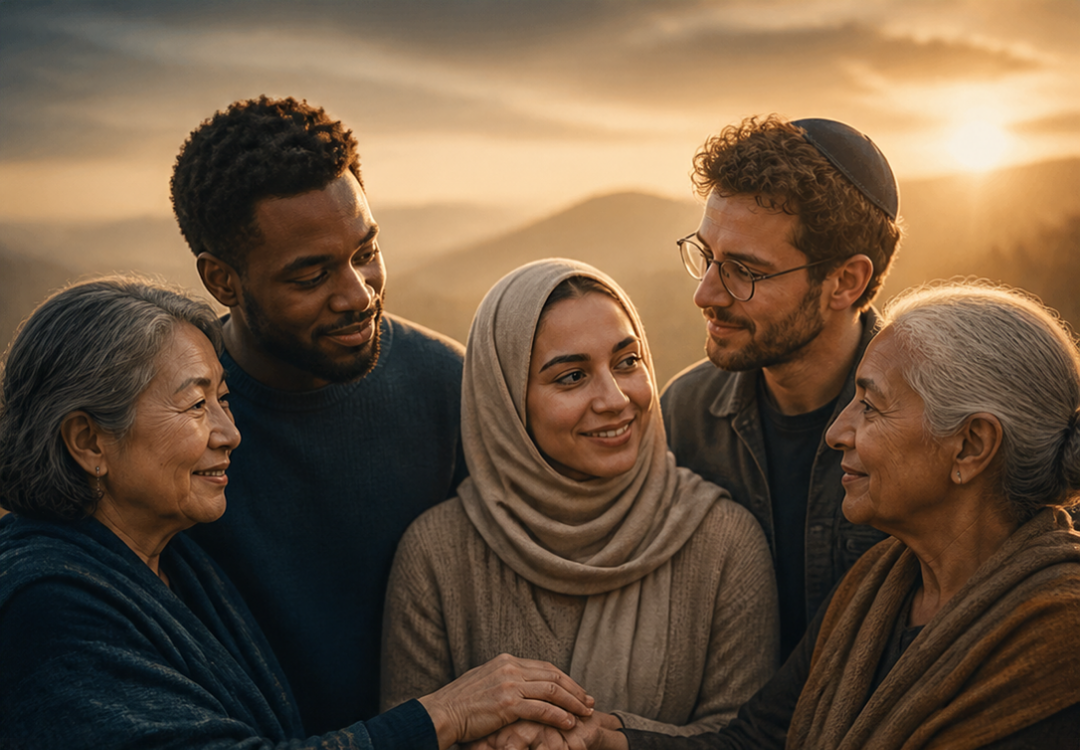
But I do believe we can look at another human being and recognize that there is something sacred about the life standing before us.
Something that existed before we knew their name.
Before we knew their religion.
Before we knew their politics.
Before we knew whether we liked them.
Something that existed before we knew their name.
In my tradition, we call that b'tzelem Elohim.
Created in the image of God.
And so I leave you with this thought.
The next time you look into the eyes of another human being, remember what you are looking at.
You are looking into the image and likeness of God.
Not because that person has earned it.
Not because that person agrees with you.
Not because that person has lived a perfect life.
But because the image was already there.
And if we can remember that — especially when it is difficult — perhaps we will begin treating one another with the dignity that has belonged to us all along.
שלום,
Student Rabbi Ben
References
א The Qur'an speaks of the dignity of every human being in Surah al-Isra: “We have honoured the children of Adam” (17:70).
The Qur'an. Translated by M. A. S. Abdel Haleem, Oxford UP, 2004. Quran.com, quran.com/al-isra/70?translations=85.