
The Righteousness of Silence
Delivered by Student Rabbi Ben Russell on Erev Shabbat Noach 5787
Last week, we encountered one of the most troubling questions in the Torah.
After Cain kills his brother Abel, God asks him where his brother is.
And Cain responds, “Am I my brother's keeper?”
Am I my brother's keeper?
It's a question that has followed humanity ever since.
How much responsibility do we bear for one another? Where does our responsibility begin? And where does it end?
This week, the Torah takes that question and places it on a much larger stage.
We meet Noah.
And the Torah tells us something extraordinary about him.
Noach ish tzaddik tamim hayah b'dorotav.
Noah was a righteous man, blameless in his generation.
Think about what that means.
Noah lives in a world the Torah describes as filled with violence and corruption. And somehow, in the middle of all of that, he manages to remain righteous.
He doesn't simply go along with everyone else.
He doesn't surrender his integrity to the world around him.
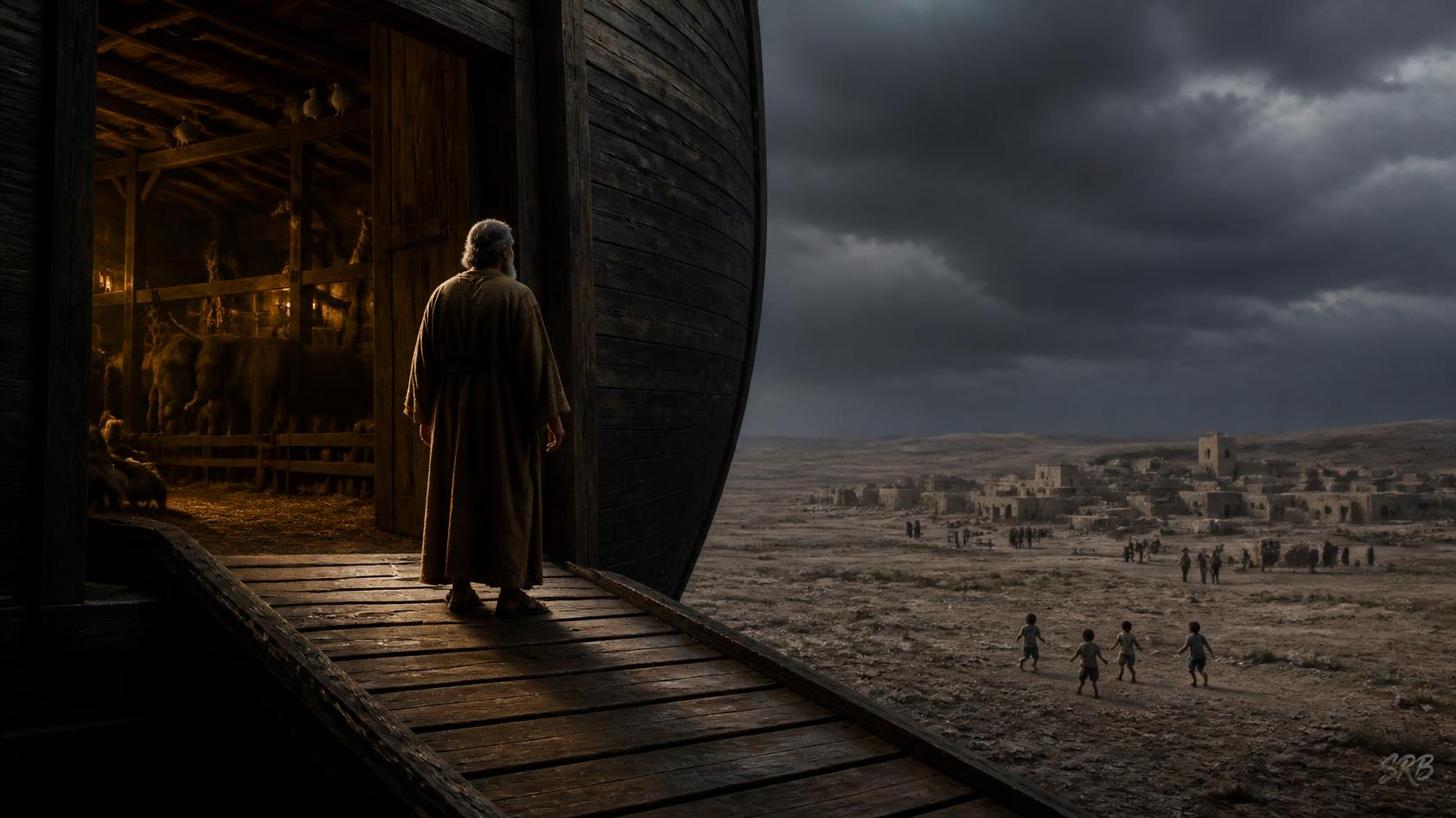
And when God tells him to build an ark, Noah does something remarkable.
He builds it.
He preserves his family. He gathers the animals. He carries life through a catastrophe that threatens to destroy it.
We should not underestimate what Noah accomplishes.
But there is something else about his story.
Something that isn't there.
When God tells Noah that the world is going to be destroyed, Noah doesn't argue.
He doesn't ask whether the people around him might be spared.
He doesn't plead for mercy.
At least, the Torah never tells us that he does.
And that silence is interesting.
Because the Torah has already told us that Noah is righteous.
So perhaps the question isn't whether Noah is a good person.
The question is whether being a good person is always enough.
So perhaps the question isn't whether Noah is a good person.
The question is whether being a good person is always enough.
There is a difference between refusing to participate in wrongdoing and being willing to confront it.
There is a difference between preserving our own integrity and accepting responsibility for the people around us.
And those differences aren't always easy to navigate.
There is a difference between refusing to participate in wrongdoing and being willing to confront it.
We cannot intervene in every injustice.
We cannot rescue everyone who suffers.
And sometimes, stepping into someone else's situation can cause more harm than good.
But there are also moments when our silence matters.
Moments when we see something happening to another person, and we have to decide whether it concerns us.
In a recent address at the International Museum of Muslim Cultures, I spoke about something fundamental to our tradition.
Every single human being you look into the eyes, you are looking into the image and likeness of God.
Period.
Every single human being you look into the eyes, you are looking into the image and likeness of God.
And here's something remarkable about this week's Torah portion.
After the flood, God reaffirms that humanity is created in the divine image.
Even after all the violence.
Even after all the corruption.
Even after everything humanity has done.
The image of God remains.
That doesn't mean every human action is acceptable.
It doesn't mean we abandon accountability.
And it certainly doesn't mean that we have to allow someone to hurt us in order to prove that we care about them.
But it does mean that the humanity of another person does not disappear simply because that person has done something wrong.
And if that is true, then our responsibility toward one another becomes a much more complicated question.
Noah lived among people whose actions the Torah condemns.
But those people were still human beings.
And we are left wondering what it might have meant for Noah to see them not only as part of a corrupt world, but as people.
People who were about to die.
People whose lives, too, had begun in the image of God.
I don't know whether Noah could have changed what happened.
The Torah doesn't tell us.
And I don't think we should condemn him for failing to accomplish something we don't know was possible.
But I do think his story invites us to examine ourselves.
When we encounter people whose behavior troubles us, do we still recognize their humanity?
When we see someone suffering, do we ask whether there is something we can do?
And when we find ourselves in a position to speak, do we sometimes remain silent simply because silence is easier?
Last week, Cain asked, “Am I my brother's keeper?”
This week, Noah's story asks us to consider just how far that question reaches.
Not only to our family.
Not only to our friends.
Not only to the people we like, or understand, or agree with.
But perhaps even to those whose choices we find deeply troubling.
Noah was righteous.
The Torah tells us so, and we should believe it.
But perhaps righteousness is not the end of the conversation.
Perhaps it is where the conversation begins.
,שבת שלום
Student Rabbi Ben