

Coming Closer
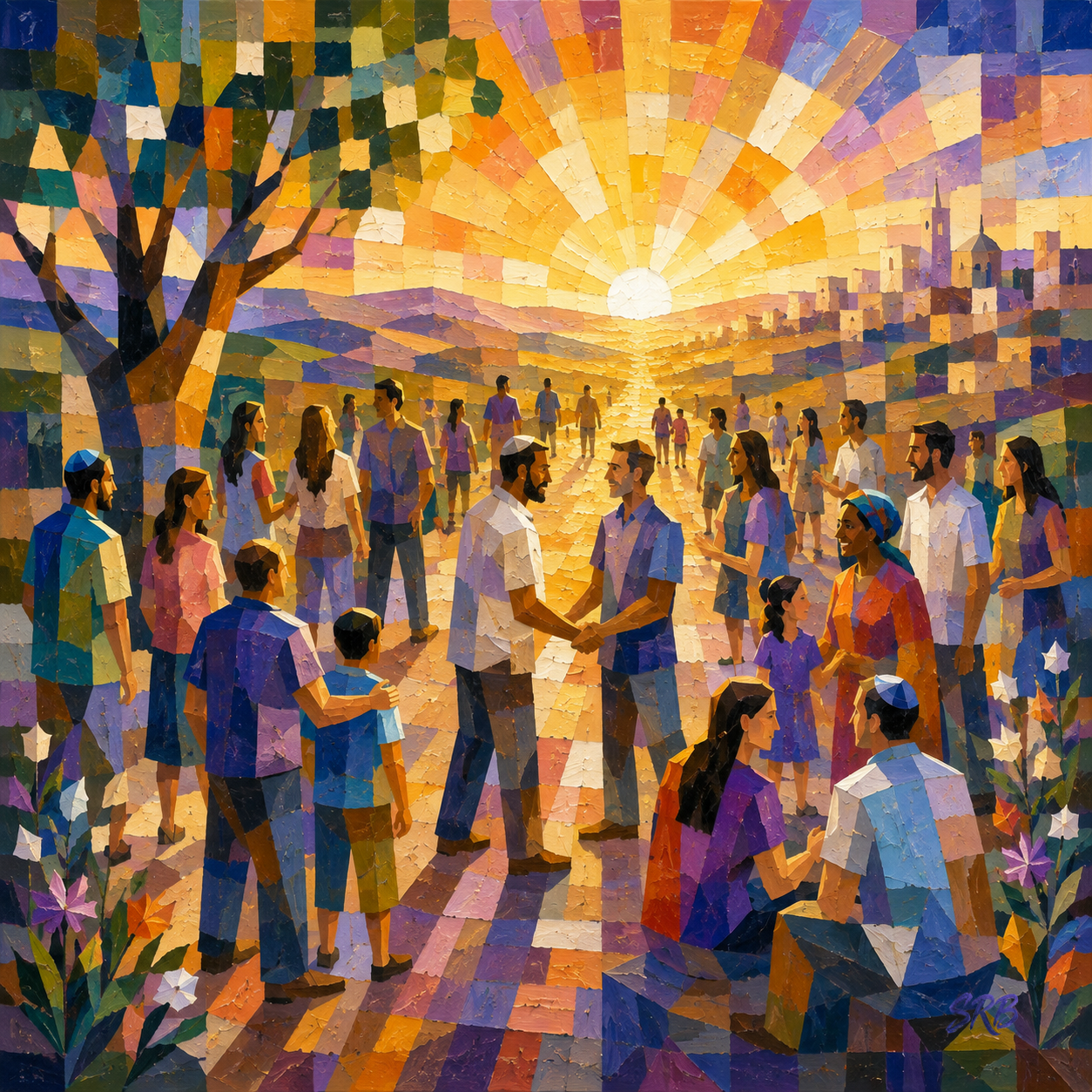
Student Rabbi Ben Russell delivered this sermon at Northminster Baptist Church on Sunday, August 16, as part of the annual pulpit swap between Beth Israel Congregation and Northminster Baptist Church. Each year the two congregations exchange pulpits in celebration of a long-standing relationship.
Genesis 45:1–15 · Deuteronomy 16:18-21:9 · Isaiah 56:1, 6–8 · Matthew 15:10–28
Before I say anything else this morning, I want to say thank you. Thank you to Northminster for welcoming me into this pulpit, and for the welcome you have extended to Beth Israel.
Our congregations have known one another for a long time. We have been neighbors and friends for decades. Long before any of us imagined the circumstances that would bring us together under this roof, there was already a relationship here. And somehow, after all these years, we are still finding ways to come closer.
Which makes the story we heard this morning feel especially appropriate. There is a moment in the Joseph story that I have always found extraordinary. Joseph's brothers are standing before him, and they have no idea who he is. Joseph, of course, knows exactly who they are.
These are the brothers who hated him. These are the brothers who stripped him of his coat, threw him into a pit, sold him into slavery, and then went home and let their father believe his son was dead. And now, years later, they are standing in Egypt before one of the most powerful men in the world. They don't recognize him. But he recognizes them.
And finally, he can contain himself no longer. He sends everyone else from the room. He begins to weep so loudly that the Egyptians hear him, that even the household of Pharaoh hears him. And then he says: "I am Joseph." (Genesis 45:3)
His brothers are terrified. And why wouldn't they be? The boy they threw into the pit now has power over them.
Joseph could have said almost anything in that moment. Instead he says: "Come closer to me." (Genesis 45:4)
Come closer.
I keep coming back to those words. Because Joseph does something remarkable here. He does not pretend the past didn't happen. Listen carefully to what he says: "I am your brother Joseph, whom you sold into Egypt." (Genesis 45:4)
He names it. You did this. You sold me.
Reconciliation, at least in this story, does not begin with forgetting. It begins with telling the truth.
And there is something else happening here. The story of Joseph asks what a person will do when power suddenly rests in his hands. There is an interesting convergence with what Jews were reading just yesterday, on Shabbat. In synagogues around the world, our Torah portion was Shoftim—(Deuteronomy 16:18–21:9) a portion deeply concerned with justice and the proper exercise of power.
Shoftim begins with a command that has become one of the most famous lines in the Torah:
Tzedek, tzedek tirdof.
"Justice, justice shall you pursue." (Deuteronomy 16:20)
And only a few verses later, Torah begins describing the limits that must be placed upon power. Even a king cannot simply do whatever he wants. The king is commanded to write and then keep a Torah beside him and read from it throughout his life. (Deuteronomy 17:18–19) And Torah tells us why: "So that his heart may not be exalted above his fellows." (Deuteronomy 17:20)
His heart. Hold onto that.
Because I think God understands something profound about human beings. The real test of justice comes when we have the power not to practice it. It is easy to speak beautifully about justice when justice costs us nothing. It is something else entirely when another human being is standing vulnerable before us and we get to decide what happens next.
And that is precisely where Joseph finds himself. His brothers once had power over him. They abused it.
So perhaps the great question in this scene isn't whether Joseph remembers what happened. Of course he remembers. The question is: What has happened to Joseph's heart? Has power exalted it above his brothers? Has suffering hardened it? Will the wounded boy use the power of the man he has become to make someone else hurt?
And Joseph answers: "Come closer to me." (Genesis 45:4)
That doesn't erase the pit. He names the wound first, and only then does he say: "You sold me here, but God sent me before you to preserve life." (Genesis 45:5)
That is a difficult theological statement. I don't think it means the pit was secretly good. And I don't believe that when terrible things happen to us, our religious obligation is to explain them away as part of some divine plan.
Joseph doesn't call the pit good. He calls it a pit.
But looking backward over his life, Joseph has discovered that evil does not get exclusive rights to determine what its consequences will mean forever. Something can begin in betrayal and end somewhere else. A wound can remain a wound without remaining the end of the story. And sometimes, after everything that has happened, there can still come a moment when someone says:
Come closer.
There is, of course, a long and complicated history standing behind a Jew speaking those words in a Christian church. Our traditions have known friendship and exchange, and they have known painful chapters too. We all know that history. We don't need to rehearse it this morning, nor do we need to be afraid of it. We simply need to tell the truth that it is there.
And then perhaps Joseph asks something more interesting of us: What happens next? What comes out of the heart now?
· · ·
Earlier this morning, praying with our children, we said words from Psalm 19 that are deeply familiar in Jewish worship:
Yih’yu l'ratzon imrei fi v'hegyon libi l'fanecha.
"May the words of my mouth and the meditation of my heart be acceptable before You." (Psalm 19:15)
Mouth and heart. What we say, and what is happening within us when we say it.
And there is a certain wonderful irony in a Jewish student rabbi standing in a Baptist pulpit and turning now to the words of Jesus. But perhaps there is something fitting about it too. Because Jesus was himself a Jew, speaking within a Jewish world, and in the Gospel passage we heard this morning he makes almost exactly that connection: "What comes out of the mouth proceeds from the heart." (Matthew 15:18)
Mouth and heart.
Deuteronomy worries that power will exalt the heart. The Psalmist prays that the words of the mouth and the meditation of the heart will be worthy. And here Jesus tells the people listening to him: Pay attention to what comes out of you. Because it tells us something about what is happening inside.
And then, almost immediately, a Canaanite woman appears. She is an outsider. She begins calling after Jesus and his disciples, begging him to help her daughter. And listen to what comes out of the disciples' mouths: "Send her away." (Matthew 15:23)
He has just told them that what comes out of the mouth proceeds from the heart. Then somebody they don't want around appears. "Send her away."
But she doesn't go. She comes closer.
And then we get to a strange and fascinating exchange. Jesus says: "It is not fair to take the children's food and throw it to the dogs." (Matthew 15:26)
Those words can sound terribly harsh to modern ears. And perhaps they should make us uncomfortable. They certainly made me uncomfortable at a first glance. But the more I read and re-read this passage, I found myself wishing the writer had given us stage directions. Because I wonder about the look that passed between Jesus and this woman.
They both know the language being used. They both know the boundary it describes. They both know what people on one side of a boundary sometimes call the people on the other. She knows it. He knows it. The disciples certainly know it.
So I cannot help wondering whether there is a knowing exchange happening here. As if he is saying: You know what they say about you. You know where everyone here thinks you belong.
And her answer is magnificent. "Yes, Lord, yet even the dogs eat the crumbs that fall from their masters' table." (Matthew 15:27)
She takes the metaphor. Turns it around. And hands it right back to him. Almost as if to say: I know. And I'm still here. She can play this game too.
And Jesus sees her. "Woman, great is your faith." (Matthew 15:28)
The disciples said: "Send her away." She came closer. And the person standing on the outside becomes the person whose faith is praised.
· · ·
And suddenly Isaiah and his reading from this morning are standing in the room with us.
"The foreigners who join themselves to the Lord…" (Isaiah 56:6)
"These I will bring to my holy mountain and make them joyful in my house of prayer." (Isaiah 56:7)
"For my house shall be called a house of prayer for all peoples." (Isaiah 56:7)
And then God says something I find particularly beautiful: "I will gather others to them besides those already gathered." (Isaiah 56:8)
Besides those already gathered.
I love those words. Because apparently being gathered is not the end of the gathering. God's gathering is never quite finished. There is always somebody else. Another person. Another people. Another relationship we had assumed could only remain at a distance.
But I wonder if there is something else in those words. Something easy to miss. Besides those already gathered. What about those already gathered?
Perhaps they are not finished either. Perhaps friendship is not finished simply because friendship already exists. Perhaps love is not finished simply because love is already real. Perhaps people who have already found one another can still come closer.
There is always more room. Another chair. Another conversation. Another meal. Another prayer. Another door to open. Another step closer.
And notice what Isaiah says just before all of this: "Maintain justice and do what is right." (Isaiah 56:1)
Which sounds remarkably close to the words Jews read just yesterday: Tzedek, tzedek tirdof. Justice, justice shall you pursue. (Deuteronomy 16:20)
Maybe justice is not only something we establish in courtrooms and laws. Maybe justice also has something to do with what we do with the relationships life hands us.
We cannot change what came before us. Joseph cannot become the boy who was never thrown into the pit. The Canaanite woman cannot unbecome who she is. We cannot rewrite the histories we have inherited.
But we can decide what happens when another human being stands before us. We can decide what comes out of our hearts now.
"Send her away." Or: "Come closer."
And perhaps that is why those words feel so appropriate in this room. Because Beth Israel and Northminster are not strangers trying to figure out whether we can become neighbors. We have been neighbors. We have been friends. Our communities have known one another for decades.
Years ago, when Northminster was building this church, you needed somewhere to worship. Beth Israel had a home. And Beth Israel opened its doors. You prayed in our house.
Years later, when fire displaced our congregation, suddenly we were the ones who needed somewhere to pray. And Northminster opened its doors. Now we pray in your house.
No one planned that symmetry. No one at Beth Israel or Northminster, all those years ago, could have known that one day our circumstances would be reversed. But once, when you needed a home, our doors were open. And when we needed a home, yours were open.
Already neighbors. Already friends. Already gathered. And still coming closer.
· · ·
And now, before I leave this pulpit, I want to return to the thank you with which I began. Because I don't want the beauty of the symmetry or the richness of our sacred teachings to allow us to pass too quickly over what your gift has actually meant.
On behalf of Beth Israel—and from me personally—thank you. Thank you for giving us more than rooms to use. Thank you for giving us a place where we could continue to gather as a congregation, where we could sing, pray, teach our children, mourn our dead, celebrate Shabbat, and remain a community while our own physical home is being rebuilt.
There is a particular vulnerability in losing a sacred space. A congregation can know perfectly well that God does not live in a building and still grieve the loss of the place where generations have prayed. You welcomed us into yours. That is a gift we will remember.
And perhaps the fire did not create the friendship between our communities. It didn't. The friendship was already here. The fire simply gave that friendship another way to become visible. And another way to grow.
Because by praying under the same roof, by seeing one another in the hallways, by hearing one another's music, by watching one another teach our children, and by learning a little more of one another's rhythms, we have been given an opportunity not simply to occupy the same building, but to know one another more deeply.
Sometimes we speak about "coming closer" as though it only belongs to people who have been far apart. As though closeness were a bridge we build once across some great divide and then the work is finished. But perhaps the deepest relationships do not work that way.
We can know one another and still come closer. We can trust one another and still come closer. We can open our doors to one another and still come closer. We can be friends for decades and discover that there is still more friendship possible.
We are two distinct faith communities. We do not have to erase those distinctions in order to love one another. We are also children of Abraham, communities shaped by ancient promises, ancient texts, ancient prayers, and a shared hope that the world can become more just, more merciful, more whole.
So my prayer for Northminster is that the hospitality you have shown us return to you many times over as blessing. May this house continue to be a house of prayer. May it continue to be a place where the stranger is welcomed, where the vulnerable are protected, where children learn to love God and neighbor, where those who grieve are held, and where those who rejoice find others ready to rejoice beside them. And may the friendship between our communities continue long after Beth Israel has returned to its own building.
Perhaps, generations from now, when someone tells the story of Jews and Christians in Jackson, Mississippi, our small piece of that enormous history will sound something like this:
Once, when the Christians needed a home, the Jews opened their doors. Years later, when the Jews needed a home, the Christians opened theirs. They had already been neighbors for decades. They were already friends. They prayed differently. They believed differently. They remained who they were. And still, they came closer.
Because God's gathering is never quite finished. There is always another door to open. Another friendship to deepen. Another step. May we keep taking it together as we continue to come closer.
Kein y’hi ratzon.
May this be God’s will