When Two Truths Meet (Parashat Shmini)
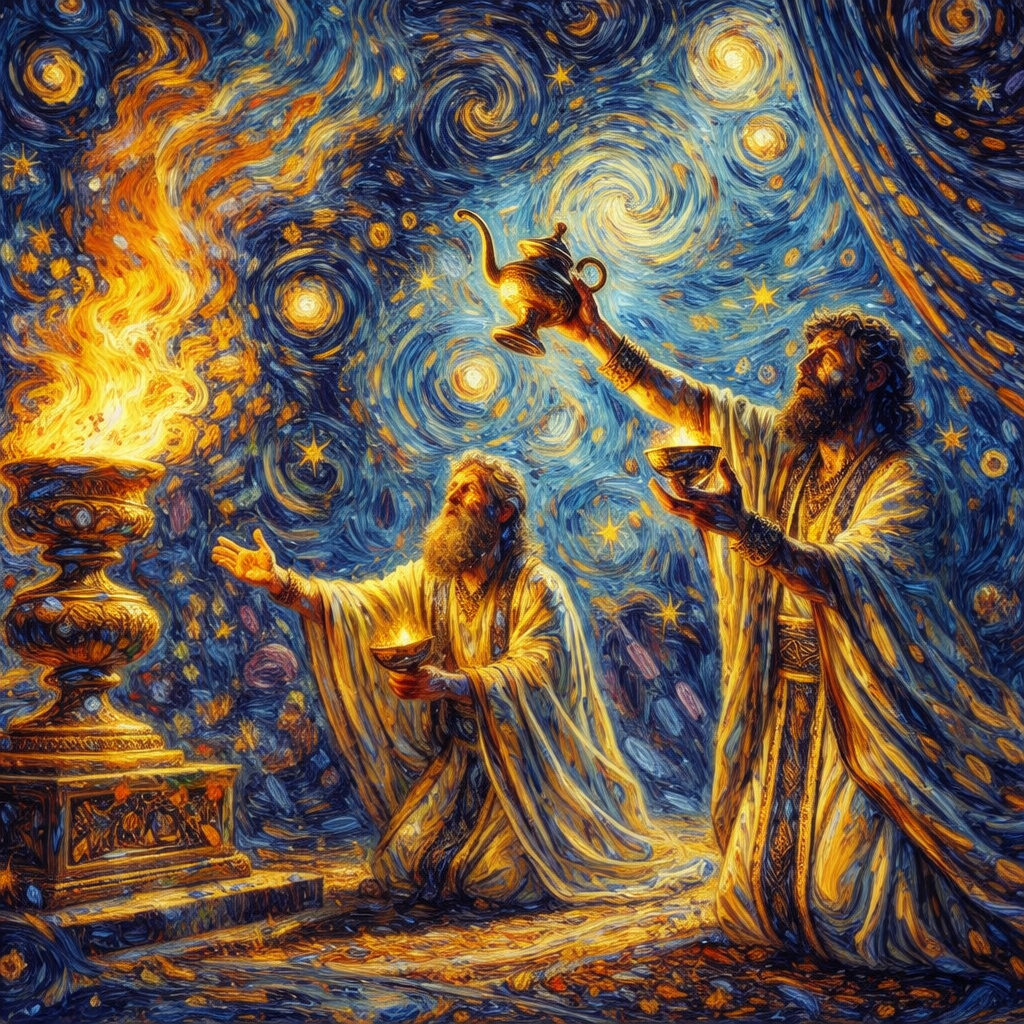
The smell would not have cleared yet.
Not the kind that disappears when the flames are gone, but the kind that settles into wood, into fabric, into pages that have been held and turned and touched for years. The air still heavy, carrying what had just happened.
Fire had come out—sudden, consuming—and two lives were gone, right there in the middle of sacred space. Nadav and Avihu.
There are moments when something happens so quickly that the body has not yet caught up, when the world has already changed but you are still standing where you were a second ago. And in that moment, Aaron stands there. And he is silent.
וַיִּדֹּם אַהֲרֹן (vayidom Aharon) (Leviticus 10:3). No speech. No protest. No explanation. Just silence.
And then, almost immediately, the scene shifts. Moses is searching. The Torah tells us he searches—דָּרֹשׁ דָּרַשׁ מֹשֶׁה (darosh darash Mosheh) (Leviticus 10:16)—insistently, urgently. Something is wrong. A ritual has not been completed the way it was supposed to be. The sin offering has been burned when it should have been eaten.
And Moses becomes angry. He turns to Aaron’s remaining sons and demands to know why. Why didn’t you do it correctly? Why didn’t you follow what was commanded?
It is easy, at first, to read this moment as a clash between right and wrong, between obedience and failure, between Moses, who knows the law, and Aaron’s family, who did not carry it out.
But that is not what is happening here. Because Aaron finally speaks, and what he says is so quiet it would be easy to miss.
“Today they brought the offerings… וַתִּקְרֶאנָה אֹתִי כָּאֵלֶּה (vatikrena oti ka’eleh) (Leviticus 10:19)—and these things happened to me. If I had eaten the offering today, would that have been good in the eyes of God?”
He does not argue the law. He does not deny what should have been done. He simply names something else that is also true. This happened to me. And in that reality, something about the ritual, even if technically correct, would not have been right.
What makes this moment so powerful is that the Torah does not give us a villain. Moses is not wrong. Aaron is not wrong.
Moses is trying to hold the world together. After what has just happened, after fire has already come out and consumed two lives, the last thing he can allow is for the system itself to begin to slip. The law must hold. The structure must remain intact.
Aaron, standing inside what has just happened, knows something Moses does not—or cannot see in that moment. That there are times when doing something exactly right can still be wrong—not because the law has changed, but because the moment has.
And then something remarkable happens. Moses hears him. Not just listens—hears. And the Torah tells us: וַיִּיטַב בְּעֵינָיו (vayitav b’einav) (Leviticus 10:20)—it became good in his eyes.
Moses, the one who brought the law down from Sinai, allows himself to be changed by what he hears in this moment. He does not double down. He does not correct. He recognizes that what Aaron has said is also Torah.
This is not a story about disagreement as failure. It is a story about what it looks like when two people are both trying, with full sincerity, to do what is right—and they arrive in different places.
And maybe that is one of the hardest spiritual truths to live with, because it means that not every conflict can be resolved by deciding who is right and who is wrong.
Sometimes, the work is different. Sometimes, the work is to stand in the presence of another truth, and to let it change what we thought we knew.
We live in a world that pushes us quickly toward certainty, toward taking sides, toward defending our position. But this moment in the Torah invites something else.
It invites us to ask: What would it look like to be as committed as Moses—and as open as Moses becomes? What would it look like to speak as honestly as Aaron, even when the truth is quiet, even when it is simply, “This is what has happened to me”?
And what might change, in our communities, in our relationships, in ourselves, if we believed that sometimes holiness lives not in choosing one truth over another, but in allowing two truths to meet and not break each other?
And maybe that is how sacred space is held together, even after everything has changed. Not because the air has cleared. Not because nothing lingers. But because, even then, we learn how to stand b’toch—in the midst of what remains, and to listen, until something new can become good in our eyes.
,שבת שלום
Student Rabbi Ben